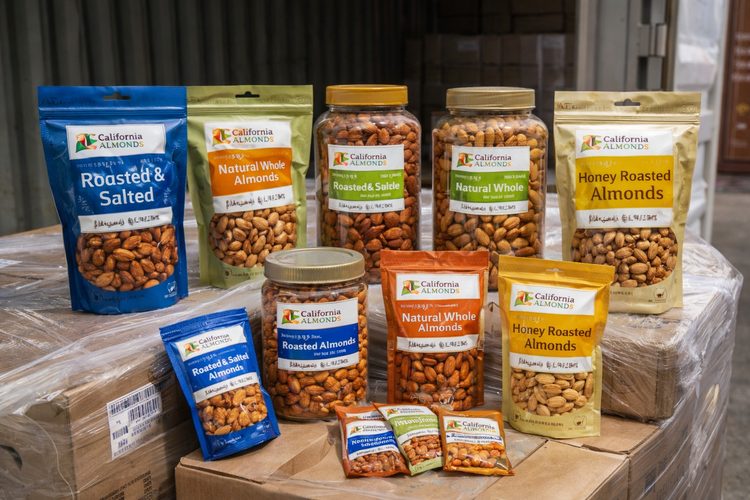
Export retail almond programs look simple from the outside. A buyer chooses almonds, picks a pouch, approves an artwork file and books a shipment. In practice, the commercial success of the line depends on a chain of linked decisions: almond form, roast style, pack size, barrier level, label architecture, carton count, pallet density, route-to-market, retail price point and the time it takes to move from approval to shelf. When one of those elements is treated as an afterthought, the program may still launch, but it becomes more fragile, more expensive or harder to scale.
Atlas approaches export retail almond lines as a product-and-logistics system rather than as a simple finished-good sale. The almond itself must fit the consumer promise, but the pack must also fit the market. A premium whole natural almond in an attractive pouch may still fail if the pack is oversized for the shelf set, if the label workflow is too slow for private label, if the carton does not cube well in a container, or if the product protection is too light for long transit and warehouse dwell time.
Main buyer takeaway: export retail almonds are not just about sourcing kernels. The best results come when product form, pack selection, destination-market fit, shelf-life protection and commercial timing are defined together before quotation.
Why export retail almond programs are different from domestic or industrial almond sales
Retail export work sits between food manufacturing and brand execution. Unlike industrial bulk programs, the buyer is not only purchasing ingredient functionality. The buyer is also purchasing shelf appearance, case configuration, label readiness and consumer usability. Unlike domestic retail work, export programs usually involve longer transit windows, more handoffs, more document checkpoints and higher exposure to temperature variation, storage risk and lead-time drift.
That is why pack selection matters so much. For roasted almonds and especially flavored or cut forms, the package is part of product protection, not just presentation. It influences oxygen exposure, moisture pickup, breakage, fill efficiency and how the product arrives after containerized transport. In commercial terms, the right package helps protect quality and also improves freight use, master-carton logic and on-shelf competitiveness.
Start with market fit, not with the pouch
Many buyers begin by asking for a pouch type or a target gram weight. That is useful, but it is not the first question. A stronger starting point is market fit: who will buy the product, in what retail setting, at what price position, and with what purchase occasion in mind? The answer changes the entire structure of the line.
1) Premium snack positioning
Premium retail programs often emphasize whole kernel appearance, cleaner artwork, stronger barrier performance, a more deliberate finish and clearer point-of-origin or quality messaging. These programs tend to favor packs that can support visual quality, stable fill presentation and a more refined brand impression.
2) Value retail positioning
Value-oriented programs usually focus more heavily on accessible price points, efficient case pack, simplified SKU architecture and practical pack materials. The product may still look good, but the commercial model is less tolerant of over-engineered packaging or unnecessarily complex variants.
3) Convenience and impulse formats
Smaller packs for convenience channels, travel retail, vending-related environments or on-the-go snacking often require a different balance between barrier, size, visual communication and unit economics. Portion control, portability and shelf readiness matter as much as kernel selection.
4) Club, family or pantry refill formats
Larger packs can improve value perception and reduce per-kilogram packaging cost, but they also increase the importance of recloseability, fill control, oxygen management after opening and consumer handling. Large packs that work in one channel do not always travel well to another.
Choosing the right almond form for export retail
The product format should match both the pack and the market. A strong export retail line usually begins with a clear answer to one question: what is the almond expected to communicate on shelf and in use? That answer determines whether the program should focus on natural whole kernels, roasted and salted lines, flavored almonds, blanched forms, diced inclusions, coated snack concepts or a mix portfolio.
Natural whole almonds
Natural whole kernels often support a clean, recognizable and internationally adaptable retail proposition. They fit wellness-oriented ranges, everyday snack programs and private-label lines that want a straightforward almonds identity. The commercial advantages are clarity and flexibility. The challenge is that visual grade, breakage control and pack presentation matter more because there is no seasoning or coating to mask inconsistency.
Roasted and salted almonds
Roasted retail lines can offer stronger flavor impact and more immediate snack appeal. They also create additional packaging sensitivity because roasted nuts need more careful oxygen management than untreated kernels. For export buyers, that means the pack discussion should begin earlier, not later.
Flavored roasted almonds
Flavored lines usually support premiumization, SKU differentiation and stronger shelf excitement. They also add complexity in coating stability, artwork claims, ingredient legend length and changeover planning. These programs can be commercially powerful when the flavor range is disciplined, but they are less forgiving of vague specifications.
Blanched, split or processed retail-ready forms
Some markets or product concepts prefer a cleaner, lighter or more culinary presentation. Blanched almonds, splits or smaller pieces may fit gifting, toppings, meal accompaniment packs or region-specific nut assortments. These formats can work well, but they change fill behavior and often need a careful discussion of breakage tolerance and visual expectation.
Buyer planning note: house specification often matters more than generic trade language in export retail. A retail buyer may require a tighter internal standard for appearance, breakage, color range or pack-bottom debris than a standard bulk discussion would suggest.
Retail pack formats and when each one makes sense
There is no universal best pack for export retail almonds. The right answer depends on product type, price position, transit exposure, shelf layout, fill weight and retailer expectations. The most useful way to think about pack selection is to compare what each format does well and where it becomes inefficient.
Pillow bags
Pillow bags can be commercially efficient for mainstream retail where speed, simple presentation and good cost control matter. They are often well suited to higher-throughput lines and straightforward salted or lightly flavored almonds. However, they may offer less premium shelf presence than a shaped stand-up pouch, and the design window can feel more limited for brands that depend heavily on shelf blocking.
Stand-up pouches
Stand-up pouches are common in premium and modern retail because they create stronger face presentation, allow useful front-panel communication and can support recloseable features. They also perform well for many export retail concepts because they help organize the product visually and often fit better with branded and private-label snack positioning. The buyer should still evaluate bottom-gusset stability, seal performance, headspace appearance and carton efficiency.
Resealable pouches
Resealable constructions are often preferred for larger packs, family formats and premium snacking concepts where the consumer is expected to use the product over several occasions. The feature adds convenience and can improve perceived value, but it also adds cost, pack complexity and a higher expectation of overall finish quality.
Jars, composite cans or rigid containers
Rigid formats can support premium gifting, pantry use, stronger stacking and more structured shelf presentation. They may also protect the product physically in ways that flexible packs do not. On the other hand, they can raise freight cost, reduce container efficiency and complicate private-label economics. For export work, the buyer should test whether the visual advantage is strong enough to justify the logistics tradeoff.
Single-serve sachets and multipacks
Smaller portion packs can be a strong answer for school, office, travel, wellness or controlled-consumption channels. They also create more packaging material per kilogram of product and may require sharper cost discipline. The commercial success of these formats depends heavily on route-to-market and margin structure.
Club and family packs
Large-format packs can work well where the customer values bulk purchase economics. They reduce packaging material per kilogram and can strengthen value messaging, but they also increase the need for good opening experience, strong recloseability and sensible post-opening product protection. They are often less suitable when the retail environment is dominated by smaller shelves or high impulse turnover.
Pack architecture is a protection decision, not just a design decision
For almonds, especially roasted and cut forms, packaging is part of quality control. Export buyers should not treat film structure, seal design and headspace management as secondary issues. Long transit times, warm storage, repeated handling and warehouse dwell can all reduce finished quality if the pack protection is too light for the route.
Moisture and oxygen sensitivity
Almonds are relatively stable when handled correctly, but roasted almonds and cut forms generally need stronger protection against oxygen and moisture than untreated bulk kernels. That makes barrier choice more important in export retail, where the product may spend longer in transit and storage before sale.
Nitrogen flush, vacuum logic and product freshness
Depending on the product and pack design, a buyer may consider controlled pack atmosphere, nitrogen flushing or other freshness-protection approaches to help preserve sensory quality. These are not marketing extras. In the right program they are part of the protection logic, especially for roasted products positioned on taste and crunch.
Physical protection and breakage control
Export retail packs must protect not only freshness but also appearance. Whole natural almonds sold at premium price points can lose value quickly if the line or logistics chain generates too much chipping, scratching or kernel breakage. Product drop height, fill weight, seal placement, case packing and pallet stacking all contribute to what the consumer ultimately sees.
Practical rule: the most attractive retail pack on a screen is not always the most reliable export pack. The correct choice is the one that protects the almond, fits the channel, cubes efficiently and still looks commercially right on shelf.
Retail sizing strategy: grams, price points and channel logic
Retail size should be chosen with commercial intent. A pack that looks efficient on the manufacturing side may still be the wrong size for the target shelf price or the shopper’s purchase occasion. Successful export retail programs usually define size architecture before artwork is finalized.
Entry pack
Smaller packs help buyers reach accessible opening price points, drive trial and support convenience or impulse channels. They can also make branded launches easier in new markets where consumer familiarity still needs to be built.
Core everyday pack
This is often the workhorse SKU. It should balance value perception, shelf productivity and freight practicality. In many programs, the core everyday pack determines whether the line becomes a repeat business rather than a one-time launch.
Premium or gifting pack
Larger or more refined packs can help build margin and shelf presence, but they should have a clear role in the range. When every SKU is positioned as premium, assortment complexity can rise faster than sales quality.
Label workflow and packaging approval are commercial bottlenecks if not planned early
Export retail projects often slow down not because the almond is unavailable, but because the pack approval path was underestimated. The buyer may need to align ingredient legend, allergen declaration, nutrition format, barcode allocation, artwork language, printer proof approval, carton marks and destination-specific packaging information. If the retail program is private label, each of those steps can involve multiple approvals.
Ingredient legend and allergen communication
Almond products are packaged foods, and allergen disclosure must be handled correctly. That becomes even more important when flavored or compound-seasoned lines add dairy ingredients, soy-based components, sesame-containing blends or other allergen-sensitive materials. The label should be built from the actual formulation and reviewed early rather than patched late.
Language and regulatory fit
Even when the product concept remains constant across markets, the labeling presentation may not. Multi-language panels, nutrition display differences, local importer details and destination-specific retail expectations can all affect the pack layout. Export buyers should assume that “same product, different market” still requires deliberate packaging review.
Artwork timelines
Artwork development, proofreading and printer coordination often take longer than first-time buyers expect. For new programs, it is useful to lock the product specification and pack dimensions early so that graphic work is not constantly revised by late-stage technical changes.
Master cartons, pallet plans and freight economics
Retail export profitability is affected by what happens outside the primary pack. Master carton dimensions, carton strength, units per case, cases per pallet, pallet height and container cube can change the total economics of the program more than small price changes in the almond itself.
Case count and handling logic
The right case pack depends on channel and warehouse handling. Too few units per case can raise freight and handling cost. Too many can make retail replenishment awkward or increase damage risk. The best answer usually balances retailer practicality with shipping efficiency.
Pallet density
Export buyers should consider whether the chosen retail pack and master carton create efficient pallet patterns without compromising product integrity. A beautiful primary pack that generates weak or unstable pallet geometry can create avoidable damage and poor freight value.
Container utilization
Export retail work rewards disciplined cube planning. Improving case and pallet efficiency can materially improve the landed-cost picture, especially on long routes. This is one reason Atlas prefers to discuss primary packaging and shipping configuration together during quotation rather than in separate stages.
Retail channel fit: where the same almond line may need a different pack
Modern grocery
Modern grocery usually rewards clean shelf presence, understandable pack sizes and good repeatability across multiple SKUs. The range should look organized and easy to compare. Overly fragmented size or flavor architecture can reduce retail clarity.
Convenience and forecourt retail
These environments often favor smaller, faster-moving packs with stronger immediate visual communication. The shopper decision is shorter, so the product needs to read quickly.
E-commerce and hybrid retail
Online and mixed fulfillment channels raise the importance of case durability, pack scuff resistance and leak prevention. What works on a shelf may need adjustment if the product is also shipped through parcel systems.
Hospitality, airline or travel channels
These channels often prioritize compact sizing, clean pack handling and strong consistency. A retail-ready almond can still work here, but it may need a different size architecture or a simpler format.
Private label supermarket programs
Private label buyers usually need tighter coordination on label format, barcode setup, carton marks, approval sequencing and reprint control. A technically simple almond line can become operationally complex if these details are not structured early.
Range building: SKU discipline matters more than buyers sometimes expect
Many first-generation export retail lines try to launch too many combinations at once: multiple sizes, many flavors, mixed pack formats and country-specific variants. That can be appropriate for mature programs, but in early-stage launches it often slows approvals and weakens replenishment discipline.
In practical terms, a well-structured core range is often stronger than an ambitious but unstable assortment. Atlas usually recommends building around a lead SKU, a clearly defined second size or flavor, and a realistic forecast path rather than opening with a large family of low-volume variants that complicate packaging and planning.
Commercial planning points Atlas would ask before quoting
For export retail almond projects, we recommend turning the product idea into a quotation brief with the following points:
- Exact almond form: natural whole, roasted, flavored, blanched or another retail-ready format
- Target market and retail channel
- Preferred pack format: pillow bag, stand-up pouch, resealable pouch, jar, can or sachet
- Target net weight and whether a size ladder is planned
- Brand owner model: own brand, distributor brand or private label
- Artwork language needs and approval workflow
- Documentation expectations and any market-specific requirements
- Trial quantity, launch volume and expected replenishment rhythm
- Preferred shipment structure: partial pallet, full truck, full container or staged launch lots
- Target timing for first production and first ship window
The purpose of this brief is not to make the conversation longer. It is to make the quotation more real. Without these details, two suppliers may both appear to be quoting “retail almonds” while actually assuming very different packaging levels, logistics models and approval scopes.
Quality assurance topics buyers should define for export retail almonds
Incoming raw material expectations
Retail programs usually need a clearer discussion of appearance, breakage, cleanliness, defect understanding and finished visual intent than industrial bulk programs do. For export work, that discussion should happen before the first production sample rather than after artwork approval.
Finished pack performance
Finished-product review should cover not only sensory quality but also seal integrity, leak resistance, print accuracy, carton durability, pack appearance after handling and expected performance through the logistics lane.
Shelf-life logic
The right question is not simply how long almonds can last in theory. The better question is how long this specific product, in this specific pack, moving through this specific route-to-market, will remain acceptable for the intended retail proposition.
Atlas planning note: in export retail, packaging should be quoted as part of the product strategy, not as a late-stage add-on. It affects product protection, landed cost, launch timing and how convincingly the almonds compete on shelf.
Buyer planning note
Atlas Global Trading Co. uses topics like this to help buyers move from broad interest to specification-minded export planning. If you are evaluating an almond retail program for export, the fastest way to improve the next conversation is to send the exact almond form, pack format, target net weight, destination market, label scope and expected volume rhythm. That gives a California supply discussion a practical commercial frame.
Whether the goal is a mainstream roasted line, a premium resealable pouch program, a private-label supermarket launch or a disciplined multi-market retail range, the same principle applies: pack selection and market fit should be designed together, because the correct export retail almond line is not only the one that can be packed, but the one that can be protected, shipped, approved, displayed and reordered successfully.
Need help sourcing around export retail almond packaging?
Use the contact form to turn this research topic into a practical retail-export brief for Atlas. The stronger the brief, the more useful the discussion on feasibility, packaging and commercial structure.
- State the almond form and target pack type
- Add destination market, label scope and launch volume
- Include pack size, timing and shipment model
Frequently Asked Questions
What is the main buyer takeaway from “Export Retail Almond Lines: Pack Selection and Market Fit”?
The main takeaway is that export retail almond programs work best when almond form, pack format, label workflow, shelf-life protection, pallet efficiency and market positioning are defined together.
Why does pack selection matter so much in export retail almonds?
Because the pack influences more than presentation. It affects product protection, freight efficiency, master carton logic, shelf appearance, consumer handling and the practical economics of the route to market.
Which almond formats are most common for export retail programs?
Common forms include natural whole kernels, roasted salted almonds, flavored roasted almonds, blanched almonds and value-added retail snack concepts. The right choice depends on the target price band, channel and consumer expectation.
What should be defined before requesting a quotation for export retail almonds?
A strong quotation brief should define the almond form, roast or flavor style, target pack size, packaging type, destination market, language needs, documentation requirements, expected trial or launch volume and first-shipment timing.
Can the same export retail logic apply to both branded and private-label almond programs?
Yes. The same product-and-pack logic applies to both, although private-label work typically requires tighter control over artwork approval, barcode setup, carton marks and change management.
Does Atlas help buyers move from article research to a quote-ready brief?
Yes. Atlas uses the same technical and commercial decision points covered in the academy to turn general export interest into a more practical sourcing conversation.