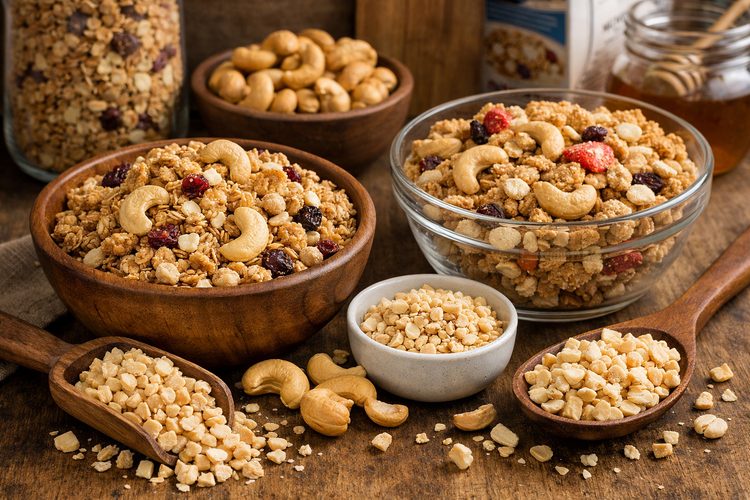
Cashews can move across multiple end uses, but cashews in granola and cereal applications are really about matching the format to the finished product, the line setup and the target consumer experience. Atlas positions cashew programs by asking what the ingredient needs to do on line and in bowl: add visible premium value, deliver a distinct crunch, support cluster structure, blend evenly without excessive fines, or contribute nut flavor without creating avoidable production inefficiency.
In granola and cereal, the right inclusion is rarely chosen on ingredient price alone. The stronger commercial outcome usually comes from aligning cut size, roast style, inclusion rate, packaging route and shipment timing before the order is placed. A buyer who asks only for “cashews for granola” may receive offers that are technically correct but operationally mismatched. A buyer who defines cut, color, bite, pack style and intended process route will usually get a more usable quotation and a more repeatable program.
Why cashews work well in granola and cereal
Cashews are attractive in granola and cereal because they can contribute both texture and a premium visual cue without overpowering the rest of the blend. Their relatively mild nut character makes them commercially versatile. They can support fruit-led granola, chocolate cereal mixes, honey or maple profiles, better-for-you snack clusters, protein blends and upscale breakfast concepts without forcing the product into a single dominant flavor direction.
From a product-development perspective, cashews are useful because they can be positioned as a premium inclusion while still offering flexibility in cut size and roast route. From a commercial perspective, that matters because one ingredient family can support several SKUs if the right cut and process route are chosen. A single supply program may serve family-size granola, portion cereal cups, snack packs and export retail lines, provided the buyer has clarified the real application demands.
Buyer shortcut: the best granola and cereal inquiry is not only “quote cashews.” It is closer to “quote roasted diced cashews for granola clusters,” “quote halves for premium cereal blend,” or “quote economical cuts for regular-use inclusion programs.”
How this topic shows up in real buying decisions
In practice, buyers compare raw, pasteurized, dry roasted, oil roasted and processed formats such as diced cuts, meal, flour, butter and oil. For granola and cereal, the most commercially relevant formats are usually whole kernels, halves, pieces and diced cuts, though flour, meal or butter may still be relevant in cereal bars, cluster systems or coated cereal products. The right choice depends on the balance between appearance, bite, blendability, oil release, label goals, bowl performance and total delivered cost.
For cashew buyers, the usable product menu often includes raw cashews, pasteurized cashews, dry roasted cashews, oil roasted cashews, diced cashews, meal, flour and butter. Which of those makes sense depends on the end use, whether the customer is manufacturing further, filling retail packs, building foodservice offerings or planning export distribution. For granola and cereal specifically, the commercial question usually becomes: what cut and treatment give the finished product the right visual density, bite and cost-in-use?
Whole, halves, pieces and diced cuts: where each format fits
Whole kernels and large pieces
Whole cashews or large pieces are mainly used when the buyer wants strong visual value. They are more likely to appear in premium granola, high-visibility muesli, upscale cereal blends or snack-forward breakfast lines where large inclusions help justify the premium position of the product. The advantage is appearance and more obvious consumer recognition. The tradeoff is cost, packing efficiency and sometimes higher breakage exposure during blending and transport.
Halves and medium pieces
Halves and medium pieces often sit in the middle ground between appearance and practical cost control. They can still be visually noticeable in clear-pack granola or premium cereal applications, but they usually distribute more easily than whole kernels. For many buyers, this is where the balance between premium impression and commercial efficiency becomes strongest.
Diced cuts
Diced cuts are commonly preferred in granola and cereal because they provide more controlled distribution and more predictable bite. They help the buyer manage portioning, reduce the visual randomness that can occur with larger pieces and often make it easier to achieve repeatable inclusion levels in every pack. Diced formats can also lower the cost of delivering visible nut content across large production runs.
Small cuts, granules and fines-sensitive applications
Smaller cuts may make sense in dense cluster systems, secondary inclusion roles or cereal applications where even distribution matters more than premium visual impact. However, smaller sizes require disciplined control because too many fines can affect bowl appearance, bottom-of-bag dusting, perceived value and fill consistency. Buyers should specify their tolerance for fines early if the product is meant to read as premium rather than purely functional.
Raw versus roasted cashews in granola and cereal
Raw or minimally treated routes
Some buyers prefer raw or otherwise less finished formats when they plan to process further in-house or when the product will pass through an oven or coating stage as part of granola manufacturing. In that case, the receiving format should be aligned with the customer’s actual production route. The product may gain its final roast expression on the customer’s line rather than before delivery.
Dry roasted formats
Dry roasted cashews are often preferred where the buyer wants ready-developed flavor and a more direct nut note in the final cereal or granola. This can be especially useful in premium snack-style granola, indulgent cereal blends or products where bowl aroma and immediate bite impact matter. Buyers should still consider how subsequent processing and packaging will affect final texture.
Oil roasted formats
Oil roasted formats may fit certain indulgent, snack-led or heavily flavored programs, but they need to be evaluated carefully against the overall formulation, label strategy and shelf-life logic. They are not automatically the best choice for every cereal route simply because they can offer a strong flavor signal. The correct decision depends on the broader commercial brief.
How cashews behave in granola systems
Inclusion during bake or mix
Granola systems vary widely. Some producers include nuts before baking, others apply them later, and some use mixed routes depending on cluster style and line design. Cashews can behave differently depending on when they are introduced. Buyers should therefore quote against the real process route instead of assuming that the same cut will perform equally well in all granola systems.
Cluster integrity and nut distribution
If the product is cluster-heavy, the cut size of the cashew may affect how well the nut integrates into the cluster matrix. Larger pieces can create a stronger visible cue but may distribute less evenly. Smaller cuts can support more consistent spread across the batch but may reduce the sense of premium abundance. This is a classic granola tradeoff between appearance and uniformity.
Bottom-of-bag performance
Commercial buyers often care about what happens at the bottom of the bag or carton. Excess fines, fragile pieces or poor cut control can reduce perceived quality even when the initial pack appearance is strong. That is why practical buying decisions should account for handling through mixing, filling, shipping and shelf display, not only the product as seen in a bench-top sample.
How cashews behave in cereal systems
RTE cereal blends
In ready-to-eat cereal blends, cashews are often used to signal premium quality, improve visual diversity and add a softer nut bite compared with harder nut inclusions. The buyer may want larger pieces for visibility or smaller cuts for more even cereal-to-nut distribution. The right answer depends on the product concept and price architecture.
Muesli-style and better-for-you cereals
Cashews are especially relevant in muesli-style and better-for-you cereal concepts where the inclusion mix often acts as a quality signal. Here, the buyer may prioritize natural-looking cuts, balanced distribution and a visible premium identity. Packaging route and shelf-life planning become important because the finished product is often marketed on a more wholesome or elevated positioning.
Snack-cereal hybrids
Some cereal products increasingly behave like portable snacks. In these cases, cashews can contribute both breakfast relevance and snacking indulgence. The commercial logic then starts to overlap with snack mixes, meaning the buyer may care more about roast flavor, bite integrity, visual size and repeated consumer perception from pack to pack.
What buyers usually need to specify before quotation
For cashew projects in granola and cereal, Atlas would generally recommend translating the product idea into a quote request with specific technical and commercial inputs. That makes it easier to discuss realistic California partner options instead of a generic price-only inquiry.
- What is the exact application: granola cluster, loose granola, cereal blend, muesli, snack cereal, cereal bar or another breakfast format?
- What cut is required: whole, halves, pieces, diced or a more economical inclusion size?
- Should the cashews be raw, pasteurized, dry roasted or oil roasted?
- Is the priority premium visual value, controlled bite, even distribution or tighter cost-in-use?
- What inclusion rate is planned in the finished product?
- Will the cashews be blended before baking, after baking or in a separate finishing step?
- Is the program industrial bulk, foodservice, retail-ready, private label or export-oriented?
- What is the projected volume rhythm: trial quantity, validation run, launch volume or repeat replenishment?
- What destination market, shelf-life requirement and packaging route should shape the quote?
Typical use cases for cashews on this website include snacks, bakery, confectionery, plant-based dairy and spreads. In granola and cereal, the product brief should always connect the cashew format to bowl performance, blend behavior and the real cost structure of the finished product.
Commercial planning points
Commercially, these projects often develop in stages: trial quantity, validation run, launch volume and repeat replenishment. Atlas uses that logic to guide pack and shipment planning, especially when retail packaging, export retail or private label is part of the conversation. Granola and cereal programs often look simple from a distance, but they become highly structured once the buyer has to maintain consistent inclusion quality across repetitive high-volume runs.
When relevant, the brief should also mention whether the program is industrial bulk, foodservice, retail-ready, private label or export-oriented. That single clarification often changes packaging, documentation and timing assumptions. A cereal plant may prioritize line efficiency and delivered cost. A premium retail granola line may prioritize visible cut quality and bag appearance. An export route may increase the importance of packaging, shelf-life timing and transit resilience.
Buyers should also compare offers on cost-in-use rather than nominal product price alone. A cheaper cut may create more fines, weaker visual density or less consistent pack appearance. A slightly more expensive cut may deliver better distribution, stronger premium cues or lower complaint risk. In granola and cereal, the usable value of the cashew is measured not only by purchase price but by how well it performs in the finished blend.
How Atlas thinks about specification-minded granola and cereal buying
Atlas generally encourages buyers to move away from broad ingredient language and toward functional sourcing language. In granola and cereal, that means defining whether the cashew should read as a hero inclusion, a supporting premium ingredient or a cost-controlled nut component inside a larger blend. That single distinction often drives the right answer on cut size, roast style, packaging and volume planning.
A premium cereal line may justify larger and cleaner cuts. A value-engineered granola may need smaller cuts with strong distribution. A cereal bar inclusion may require a different route again. The buyer who defines this clearly is far more likely to receive a useful, comparable quotation.
Buyer planning note
Atlas Global Trading Co. uses topics like this to move conversations from broad interest to a specification-minded inquiry. If you are evaluating cashews for granola and cereal applications, share the target cut, roast preference, inclusion role, pack style, estimated volume and destination using the floating contact form so the next step can be grounded in a real commercial need. The practical goal is not simply to buy cashews for breakfast products. It is to source the right cashew format for the blend, bowl experience and commercial position your finished line is intended to deliver.
Need help sourcing cashews for a granola or cereal line?
Use the contact form to turn this research topic into a practical quote request with cut size, roast style, pack route and commercial timing.
- State the exact cashew format and inclusion role
- Add target monthly or trial volume
- Include destination market and target timing
Frequently Asked Questions
Which cashew formats are most useful in granola and cereal applications?
Whole kernels, halves, pieces and diced cuts are the most common formats. The best option depends on whether the product needs premium visual impact, controlled distribution, a specific bite profile or tighter cost management in the finished cereal blend.
What should buyers specify before requesting a quote for granola or cereal use?
Buyers should specify the target cut size, roast style, inclusion rate, packaging route, production method, destination market, expected monthly volume and whether the product is for industrial bulk, foodservice, retail-ready or export sale. Those details make quotations much more practical to compare.
Why is cut selection so important for cashews in granola and cereal?
Cut selection affects distribution, bite, visual consistency, breakage, cost-in-use and how the product performs during blending, baking, filling and transport. The correct cut can reduce waste and improve the finished eating experience.