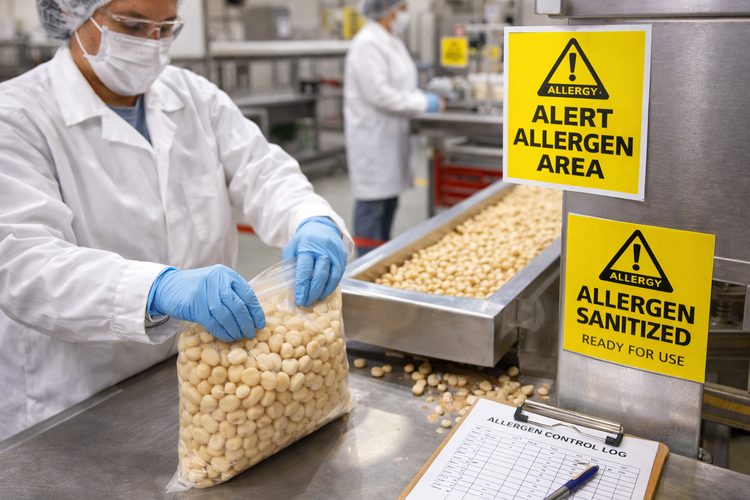
Allergen control is one of the most important non-price topics in industrial nut sourcing. In macadamia programs, buyers are not only evaluating flavor, format, roast style and pack configuration. They are also evaluating whether the supplier’s operating environment, cleaning discipline, handling sequence and documentation framework are compatible with the buyer’s own food safety obligations. In practice, strong allergen control is part of commercial reliability. A program that looks acceptable on paper can still be a poor fit if the processor’s segregation, sanitation or label-control systems do not align with the buyer’s internal standards.
For Atlas, this topic matters because macadamias are usually sourced into regulated, specification-driven environments: bakery, confectionery, snack manufacturing, plant-based dairy, sauces, dips, private label and export retail. In each of those channels, the conversation can quickly move beyond ingredient price and into questions about plant design, shared equipment, production scheduling, warehouse handling, pack integrity and the support documents a customer may need for supplier approval or customer-facing audits. That means allergen controls are not separate from commercial planning. They are part of the sourcing decision itself.
Why allergen controls matter in real buying decisions
Industrial buyers usually need more than a general assurance that a supplier “takes allergens seriously.” They need to understand whether the allergen-control approach is operationally credible and commercially usable. That often includes how raw materials are received, how products are segregated, what other allergens are handled in the facility, whether scheduling is used to reduce cross-contact risk, how sanitation is performed, how changeovers are documented and how packaging and labels are verified before release.
In practical terms, allergen controls can affect whether a buyer can approve a supplier at all, whether a label claim or advisory statement remains acceptable, whether the program fits a customer specification, and whether export documents can be prepared consistently. The issue is therefore not only technical. It is tied to risk tolerance, customer requirements, brand protection and the cost of disruption if a product needs to be reworked, re-labeled, held or rejected.
Main buyer takeaway: in macadamia sourcing, allergen control works best as part of the specification from the start. Buyers usually get better outcomes when product format, processing route, pack style, documentation needs and allergen expectations are defined together.
What buyers are actually reviewing
When buyers ask about allergen controls in macadamia processing and packing, they are usually trying to answer a few core questions. First, what allergens are present in the facility or wider operation? Second, how are products, people, tools and packaging managed to reduce cross-contact risk? Third, what evidence exists to support those claims? And fourth, does the resulting control program fit the buyer’s own manufacturing, labeling and customer-approval requirements?
Those questions may sound straightforward, but the answers are often operational rather than theoretical. A buyer may need to know whether macadamias are processed on dedicated equipment or shared equipment, whether runs are sequenced from lower-risk to higher-risk products, whether rework is controlled tightly, whether storage zones are separated, and how finished goods are identified after packing. This is why detailed pre-quote conversations are often more valuable than generic assurances in a sales deck.
Facility context changes the conversation
Allergen discussions are not one-size-fits-all because facility context matters. A processor handling only macadamias and very limited product variation presents a different control picture from a site handling multiple tree nuts, peanuts, dairy-containing seasonings, chocolate systems or other allergen-bearing materials. Buyers do not always need zero-complexity operations, but they do need to understand the real control environment.
For this reason, commercial discussions often move beyond the macadamia ingredient itself and into a broader facility review. A buyer may ask what other products run in the plant, whether raw and finished goods follow separate traffic patterns, how utensils are controlled, whether packaging lines are shared, and how label changes are managed during transitions. The detail level depends on the customer and application, but the underlying goal is consistent: reduce ambiguity before approving the program.
Segregation and zoning in macadamia handling
Segregation is one of the first operational areas buyers review. In a credible allergen-control program, segregation can include physical separation, controlled storage locations, clearly identified work-in-progress containers, differentiated tools, line-side material discipline and restricted movement practices. For buyers, the point is not simply whether a facility uses the word “segregation,” but whether segregation is built into daily operating routines.
In macadamia programs, segregation discussions may cover raw kernel storage, diced and processed forms, roasted versus raw product, butter or oil derivatives, rework management, packaging material staging and the path finished goods follow after packing. Buyers in private label, industrial manufacturing and export channels may each emphasize different parts of that chain. The core logic remains the same: if materials, tools, packaging or labels can be mixed incorrectly, the risk becomes commercial as well as technical.
Production scheduling as an allergen-control tool
One of the most practical control measures in shared processing environments is production scheduling. Buyers often want to know whether the processor sequences production in a way that helps reduce cross-contact risk. That can mean running simpler products before more complex products, grouping similar product families together, or building cleaning steps and verification points between dissimilar runs.
This matters because scheduling is often the bridge between theory and execution. Even where full physical separation is not possible, strong sequencing can reduce unnecessary exposure points and make sanitation more manageable. From a buyer’s perspective, this affects the credibility of the control program and the confidence that repeat shipments will be produced under consistent operating logic.
Operational note: buyers often pay close attention to how a processor schedules runs, because sequencing is one of the clearest indicators that allergen control is being managed operationally rather than only administratively.
Cleaning, sanitation and verification
Sanitation is another major review point. In macadamia processing and packing, buyers usually want to understand not only whether cleaning is performed, but how it is defined, when it is triggered, how it is verified and what records support it. A supplier conversation may therefore include dry-cleaning practices, wet-cleaning where applicable, tool control, line clearance, visual inspection, swabbing or other verification approaches depending on the facility and product route.
From a commercial standpoint, this matters because sanitation discipline influences uptime, changeover realism, audit readiness and the supplier’s ability to support specification-driven customers. A processor may have excellent product availability, but if the cleaning and verification framework does not fit the buyer’s supplier-approval requirements, the program becomes harder to approve or sustain. This is especially relevant where the buyer serves large retail, foodservice or branded-manufacturing customers with formal supplier-review systems.
Packaging and label controls
Packaging controls are often underestimated in allergen management, but they are among the most load-bearing steps in the program. Buyers typically want to know how packaging materials are identified, how obsolete labels are removed from line areas, how pack copy is verified before start-up, how finished cases are checked during runs, and how product identity is maintained through palletization and release. In private label and export work, this becomes even more important because multiple pack designs, languages or market-specific statements can increase the complexity of line control.
In real terms, a strong allergen-control program is not only about avoiding cross-contact in product handling. It is also about avoiding incorrect labels, incorrect advisory statements, mixed carton components or misidentified finished goods. The packaging step is therefore part of the allergen conversation from the buyer’s point of view, not an administrative detail to be handled later.
Warehouse and finished-goods handling
Once macadamias are processed and packed, the risk conversation does not end. Warehouse controls still matter. Buyers may ask how finished goods are stored, how lots are identified, how partial pallets are handled, how returns or hold stock are segregated and how shipping accuracy is checked. These details can seem operationally routine, but for a buyer they contribute to confidence that the program is controlled from input through dispatch.
This is particularly relevant for industrial bulk and export programs where finished packs may remain in storage longer, travel farther or move through multiple logistics points before use. A well-structured warehouse discipline supports not only food safety but also traceability, release control and customer confidence in the shipment process.
Documentation buyers often request
Commercially, allergen control becomes concrete through documentation. Buyers may ask for specification sheets, allergen statements, facility questionnaires, supplier approval forms, process descriptions, cleaning summaries, lot identification practices, packaging control descriptions or audit-related information. The exact package depends on the customer, but the broader pattern is consistent: the supplier needs to translate its control program into documents the buyer can review, file and use in internal approval workflows.
That is one reason allergen controls belong in early quotation conversations. If a customer requires certain declarations or documentation formats, it is better to surface that before the commercial structure is finalized. This is especially true for export, where customer-facing documentation and market-specific expectations can differ by destination.
How the topic changes by product form
Macadamia allergen-control discussions are not always identical across whole kernels, diced cuts, roasted products, flour, meal, butter and oil. Different product forms may involve different equipment, handling steps, packaging logic or cleaning frequency. Whole kernels and diced pieces may raise more questions about line changeovers and physical handling, while butter or paste-style programs may bring more attention to tanks, pumps, transfer paths and pack-filling systems.
That means buyers should identify the exact product route in the inquiry. A request for macadamia butter under a controlled allergen-management framework is not the same as a request for raw kernels or roasted diced pieces. The more clearly the product form is defined, the more relevant the allergen-control conversation becomes.
Domestic versus export considerations
Domestic and export programs often share the same core processing logic, but they do not always share the same commercial expectations. Export buyers frequently need earlier clarity on statements, specification language, label copy, market-facing declarations and the supporting documents required by importers or downstream customers. Transit time and relabeling risk can also make packaging accuracy and document alignment more commercially significant.
For that reason, Atlas generally encourages buyers to mention the destination market early. When the shipment is export-oriented, the allergen discussion should cover not only processing and packing controls, but also how documentation and pack identity will be managed in a cross-border program.
Export note: the core control philosophy may be the same, but export programs usually require earlier coordination on statements, documentation and label handling than straightforward domestic industrial shipments.
Commercial planning points
From a trading standpoint, the best macadamia programs are built around repeatability. That means clear documentation, agreed packaging, sensible shipment cadence and a commercial structure that supports continuity rather than one-off emergency buying. Allergen controls fit directly into that framework because repeat customers do not want to re-open approval questions on every shipment. They want confidence that the same product route, control logic and documentation package can be maintained over time.
In many cases, the project also develops in stages: trial quantity, validation run, launch volume and repeat replenishment. At the trial stage, the buyer may focus on whether the facility and documentation framework can even fit the program. By launch and repeat supply, the emphasis often shifts toward consistency, change control, label discipline and the ability to support ongoing customer requirements. In each stage, allergen control remains a commercial decision driver, not a side note.
What Atlas would ask before quoting
Atlas usually encourages buyers to define intended use, pack style, destination, timeline and quality expectations early. For allergen-sensitive or highly specification-driven programs, we would also expect discussion of facility context, document requirements, pack identity needs and any customer-specific approval criteria. Those inputs reduce avoidable back-and-forth and improve comparability across California supply options.
Typical pre-quote questions include:
- What exact macadamia format is required: raw kernels, roasted pieces, flour, meal, butter or another processed form?
- Is the end use industrial bulk manufacturing, foodservice, retail-ready, private label or export-oriented?
- What allergen-related documents or declarations are needed for supplier approval?
- Does the buyer require specific discussion of segregation, scheduling, sanitation verification or packaging control?
- Will the shipment enter a facility, customer program or market with stricter statement or label expectations?
- What pack style, destination and timeline should the quotation reflect?
- Is this a trial, validation run, launch or ongoing replenishment program?
Typical use cases where this topic matters most
Typical use cases for macadamias on this website include premium bakery, cookies and confectionery, snack mixes, plant-based dairy, sauces and dips. In practice, allergen-control discussions tend to become most detailed where the buyer is supplying branded retail programs, private label lines, export customers, high-spec industrial manufacturing or multi-ingredient systems with strict internal supplier-approval rules. The product brief should always match one of those concrete end uses so the control conversation stays grounded in real commercial needs.
Common buyer mistakes
One frequent mistake is asking only whether a product “contains allergens” without discussing the wider control environment. Another is waiting until the end of the sourcing conversation to raise documentation or label-control requirements. Buyers also sometimes assume that a technically acceptable ingredient route will automatically satisfy internal approval systems, even when the document package, packaging logic or shared-facility context has not been reviewed carefully.
A better approach is to bring the allergen question into the commercial brief from the beginning. That does not mean creating unnecessary complexity. It means identifying the parts of allergen control that materially affect approval, labeling, packaging and program fit.
Buyer planning note
Atlas Global Trading Co. uses topics like this to move conversations from broad interest to a specification-minded inquiry. If you are evaluating macadamia supply and allergen controls are a meaningful part of your approval process, share the exact format, pack style, estimated volume, destination market and the type of documentation or facility discussion your team needs. That allows the next step to be grounded in a real commercial requirement rather than a generic product inquiry.
Practical inquiry template
A strong starting brief for this topic often includes:
- Product format: kernels, diced, roasted, flour, meal, butter or other processed form
- Application: bakery, confectionery, snack, plant-based dairy, sauce, dip, retail or private label
- Program type: industrial bulk, foodservice, retail-ready, private label or export-oriented
- Allergen-control needs: key document requests, facility questions or approval expectations
- Packaging needs: pack style, label sensitivity and market-facing requirements
- Volume: trial quantity, validation run, launch volume or repeat monthly program
- Destination: USA, Europe, Middle East, Asia or other target market
- Timing: target ship window, approval timeline or launch deadline
That level of detail usually leads to a more realistic sourcing conversation than a generic request for price on macadamias with a brief mention of allergen concerns.
Need help sourcing macadamias with the right control framework?
Use the contact form to turn this topic into a practical quote request with the format, pack style, destination and documentation needs your program actually requires.
- State the exact macadamia format and end use
- Add target volume, timing and destination market
- Include any allergen-control or document requirements
Frequently Asked Questions
What should buyers ask about allergen controls in a macadamia program?
Buyers should ask how the processor handles segregation, line scheduling, cleaning validation, packaging control, label verification, warehouse separation and the documentation available to support the allergen control program.
Why do allergen controls matter commercially, not just technically?
Allergen controls affect supplier approval, label claims, audit readiness, export compliance, packaging decisions and the risk of costly production or recall issues. They are part of commercial reliability as well as food safety management.
Can allergen-control discussions differ between domestic and export macadamia programs?
Yes. The core control logic may be similar, but export programs often require earlier and clearer discussion of statements, specifications, supporting documents and market-specific labeling expectations.