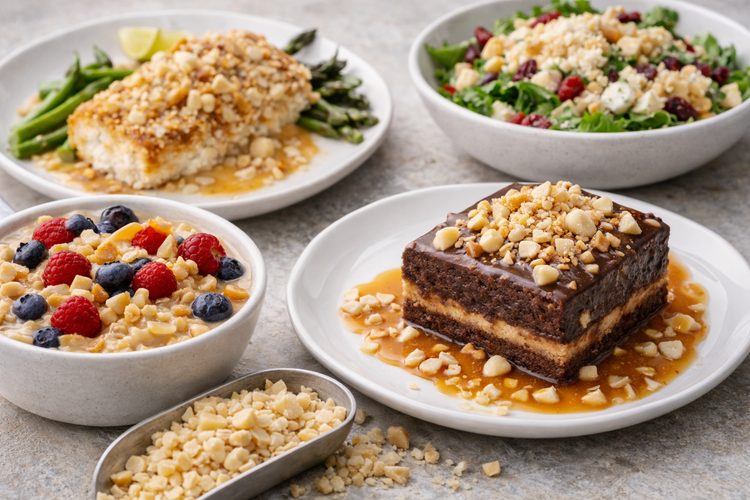
Macadamias can move across multiple end uses, but foodservice uses for macadamias are really about matching the format to the menu function. A foodservice operator is rarely buying macadamias only as a raw commodity. The buyer is usually trying to solve a service problem or elevate a menu: add premium crunch to a dessert, deliver rich nut flavor in a sauce, create a high-value garnish for plated dishes, support a luxury cookie or pastry line, improve buffet presentation, or give a breakfast and brunch concept a more distinctive premium cue.
Atlas generally positions macadamia programs by asking what the customer needs the ingredient to do in the kitchen, on the line and at service. Should the product add crunch, deliver creaminess, support a premium visual, carry seasoning, contribute nut flavor without slowing prep, or hold up through staging and service? Those questions usually matter more than the broad category name alone.
Foodservice buyer view: The strongest commercial result usually comes from aligning menu application, cut size, roast route, pack style and re-order rhythm before the order is placed. Foodservice kitchens need ingredients that perform consistently, not just ingredients that look attractive in a sample bag.
Why macadamias are relevant in foodservice
Macadamias occupy a premium position in the nut category. They carry strong sensory and commercial value because of their buttery taste, rich mouthfeel, relatively tender bite and upscale menu associations. In foodservice, those attributes can be translated into higher perceived dish value, stronger menu differentiation and more elegant plating. Operators often use macadamias when they want a nut inclusion that reads more luxurious than a standard topping and less aggressive than harder, drier nut options.
That premium character makes macadamias especially useful in hotel and resort foodservice, upscale bakery counters, premium coffee and dessert concepts, airline and lounge catering, contemporary breakfast menus, plated restaurant desserts, confectionery-adjacent pastry programs, and selected savory applications where buttery richness is part of the appeal. The commercial point is not simply that macadamias are expensive; it is that they can justify a premium menu impression when the correct format is selected.
How this topic shows up in real buying decisions
In practice, buyers compare raw, pasteurized, dry roasted and processed formats such as diced cuts, meal, flour, butter and oil-bearing systems. The right choice depends on the balance between appearance, bite, blendability, oil release, label goals, prep practicality and total delivered cost. A pastry kitchen buying roasted diced macadamias for cookies is dealing with a different use case from a hotel breakfast program buying large pieces for topping stations or a dessert manufacturer using macadamia paste in fillings and sauces.
For macadamia buyers, the usable product menu usually includes raw macadamias, roasted macadamias, diced macadamias, granulated cuts, meal, flour, butter and paste. Which of those makes sense depends on the end use, whether the customer is manufacturing further, using the ingredient directly in back-of-house service, building retail-adjacent packaged offerings, or planning foodservice distribution into regional or export channels.
Common foodservice use cases for macadamias
Plated desserts and pastry finishing
Macadamias are frequently used in plated dessert work because they add both visual luxury and rich nut character. Depending on the concept, chefs may use toasted halves or pieces for garnish, candied macadamias for crunch, granulated cuts for plate accents, or macadamia butter and paste in creams, mousses, fillings and praline-style components. In these applications, the buyer typically cares about appearance, roast consistency, bite and kitchen usability rather than only bulk commodity price.
Ice cream, gelato and dessert station topping
Foodservice dessert stations and scoop concepts often need a nut inclusion that signals premium quality immediately. Macadamias can work as topping pieces, inclusions in house-made frozen desserts, mix-ins for plated sundaes or textural accents in premium parfaits. Here, cut size and roast route matter because the product must remain attractive in open service, deliver clean bite and be easy to portion quickly.
Bakery and café programs
Macadamias are widely associated with premium cookies, muffins, brownies, blondies, loaf cakes, breakfast pastries and high-end laminated bakery applications. Foodservice bakery buyers may use whole or large pieces for visible premium effect, medium pieces for dough distribution and cost control, or meal and flour in fillings and specialty applications. In this environment, the ingredient must work well both on the prep bench and in the finished display case.
Breakfast and brunch menus
Macadamias can elevate breakfast and brunch with strong premium cues. Typical uses include topping for oatmeal, yogurt bowls, granola stations, pancakes, waffles, French toast, açai-style bowls, fruit plates and hotel buffet offerings. These applications often prefer pieces or roasted cuts that deliver attractive garnish value while staying easy to portion in back-of-house operations.
Savory menu applications
Although often associated with sweets, macadamias can also be used in select savory dishes where richness and texture are assets. Examples include crusts for fish or poultry, finishing for roasted vegetables, premium salad toppings, rice and grain bowl garnish, and buttery nut accents in sauces or dressings. In these cases, the operator may favor roasted pieces, coarsely chopped macadamias or specially seasoned formats depending on the cuisine style and service model.
Sauces, dips and spreads
Macadamia butter, paste and fine particulate formats can be relevant in foodservice kitchens producing nut-forward sauces, dessert spreads, pastry fillings, plant-based creamy components or specialty dips. For these programs, visual identity may matter less than smoothness, flavor and process behavior. The buyer should define whether the ingredient is acting as a visible nut component or as a functional flavor-fat system within a recipe.
Matching format to the foodservice application
Whole kernels and halves
Whole kernels and halves are useful when the menu wants clear premium visual impact. They can work well in cookies, buffet presentation, plated garnishes, chocolate applications and retail-adjacent café bakery items. The commercial tradeoff is that whole kernels often cost more and may be unnecessary where the nut is not consumer-visible.
Large and medium pieces
Pieces often give foodservice buyers the best balance between premium appearance and operational practicality. They are easier to portion, easier to fold into doughs or batters and often more efficient in menu systems where whole kernels would add cost without proportional value. Medium pieces can be especially practical in pastry kitchens, cookies, granolas, topping stations and dessert inclusions.
Diced cuts and granulated material
Diced and granulated formats are useful when consistency matters. They allow more even distribution, more predictable portion control and often better yield management in high-volume operations. In chain foodservice, airline catering, hotel buffet programs and commissary-prepped desserts, that repeatability can be commercially more important than dramatic appearance.
Meal and flour
Macadamia meal and flour are typically used where the operator wants flavor contribution, recipe integration or specialty texture effects rather than visible nut identity. These formats may be suitable for pastry fillings, crusts, coatings, bakery blends, dessert bases or specific premium recipe systems. Buyers should specify whether they need a coarser meal or a finer flour-like texture because the functional outcomes differ.
Macadamia butter and paste
Butter and paste formats are relevant in sauces, pastry creams, fillings, frozen dessert bases, plated dessert components and plant-based menu concepts. In these applications, the buyer should clarify whether smoothness, spreadability, flow behavior or flavor intensity is the top priority. Those factors are more useful commercially than ordering a generic macadamia paste without application context.
Raw versus roasted in foodservice use
The raw-versus-roasted decision is not only a flavor question. It is also a labor and process question. Raw macadamias may make sense when the kitchen or manufacturer wants to apply its own roast, seasoning or further transformation. Roasted material often makes more sense when the operator wants a ready-to-use ingredient with developed flavor and less prep burden.
In foodservice, roasted macadamias are frequently preferred for toppings, garnishes, buffet use, cookie inclusions and direct service applications because they reduce back-of-house work. Raw material may still be attractive for pastry kitchens or culinary teams that want more control over final flavor development. The right answer depends on whether the foodservice buyer is using the ingredient directly or building it into a broader process.
What matters technically in foodservice sourcing
Appearance and premium perception
Because foodservice often sells with the eye first, appearance matters. Whole kernels, attractive roasted pieces and clean cuts can justify premium menu pricing more effectively than undifferentiated particulate formats. For plated desserts, bakery counters and buffet displays, the visual payoff of the nut may be part of the value proposition.
Bite and texture
Macadamias are valued for a rich, buttery, less aggressive bite compared with some harder nuts. That said, cut size still matters. Oversized pieces can be awkward in fine pastry or delicate desserts, while overly small particulate can disappear and lose menu impact. Buyers should source around how the guest experiences the dish, not just how the ingredient looks in the carton.
Oil release and recipe interaction
Macadamias are naturally rich in oil, which can be beneficial in some systems and challenging in others. In cookies, fillings, sauces and pastry components, oil behavior can affect texture, mouthfeel and recipe balance. This is one reason foodservice buyers should identify whether the macadamia is decorative, structural or functional inside the recipe.
Ease of portioning and kitchen handling
Foodservice kitchens often value labor efficiency as much as ingredient quality. A more precise cut size or ready-to-use roasted format may be commercially preferable if it saves prep time, reduces trimming, speeds mise en place or improves portion consistency. This is especially relevant in chain foodservice, hotel operations and high-throughput dessert stations.
Pack format and storage behavior
Foodservice buyers do not always want the same pack format as industrial manufacturers. Some prefer larger bulk formats for central kitchens and commissaries. Others need smaller working packs for restaurant units, pastry labs or topping stations. The right pack should fit storage space, throughput speed and handling realities, not just shipping logic.
How this topic affects menu development
Macadamias can change how a menu item is perceived. A cookie becomes more premium when the visible inclusion supports a recognized luxury profile. A dessert feels more intentional when the nut garnish contributes both crunch and buttery flavor. A breakfast bowl can be repositioned upward when the topping selection moves beyond standard granola or commodity nuts. In commercial terms, the ingredient is not just a recipe line. It is often part of the menu storytelling and margin strategy.
That is why the quote should reflect the real menu use. Whole or kernel material is different from diced cuts, meal, flour, butter or paste. The commercial logic also changes when the material is raw, roasted or chosen for direct service versus kitchen processing.
What Atlas would ask before quoting
For macadamia foodservice projects, Atlas generally recommends translating the product idea into a quote request with five points: target format, application, pack style, destination market and volume rhythm. That makes it easier to discuss realistic California partner options instead of a generic price-only inquiry.
For foodservice in particular, Atlas would also usually ask whether the product is for kitchen prep, direct garnish, buffet service, dessert station use, pastry production, frozen dessert application or a ready-to-portion topping system. That clarification helps determine whether the best format is whole, pieces, diced, meal, flour, butter or paste, and whether roasted ready-to-use product makes more sense than raw material.
Typical use cases for macadamias on this website include premium bakery, cookies and confectionery, snack mixes, plant-based dairy, sauces and dips. The product brief should always match one of those concrete end uses, even when the final channel is foodservice, because the application still drives the correct specification.
Commercial planning points
Commercially, foodservice projects often develop in stages: trial quantity, validation run, launch volume and repeat replenishment. Atlas uses that logic to guide pack and shipment planning, especially when hotels, restaurant groups, cafés, caterers, commissaries or premium packaged foodservice programs are part of the conversation. A single-location pastry kitchen may need a smaller, more flexible program. A regional hospitality group may need more disciplined replenishment and standardized pack sizes.
When relevant, the brief should also mention whether the program is industrial bulk, foodservice, retail-ready, private label or export-oriented. That single clarification often changes packaging, documentation and timing assumptions. Foodservice is its own commercial lane: it often needs a balance between ingredient performance and operational convenience.
Cost-in-use versus nominal price in foodservice
Foodservice buyers should be careful not to judge macadamia programs only on nominal price per pound or kilogram. A lower-priced raw format may require roasting, chopping or extra prep that increases labor cost. A cheaper large piece may create uneven portioning or plate inconsistency. A slightly more expensive roasted diced format may save time, improve garnish control and produce a more reliable guest experience.
That is why cost-in-use often matters more than invoice price alone. In foodservice, the ingredient must perform in a working kitchen, not just in a warehouse. The correct commercial question is whether the chosen macadamia format supports margin, speed, menu quality and consistency together.
Buyer planning note
Atlas Global Trading Co. uses topics like this to move conversations from broad interest to a specification-minded inquiry. If you are evaluating macadamia supply for foodservice, share the format, pack style, estimated volume and destination using the floating contact form so the next step can be grounded in a real commercial need.
Whether the need is for roasted pieces in hotel bakery programs, elegant garnish for plated desserts, topping formats for premium café menus, or butter and paste for back-of-house recipe systems, the strongest sourcing result usually begins with a simple question: what exactly does the kitchen need the macadamia to do?
Need help sourcing around this macadamia foodservice topic?
Use the contact form to turn a broad menu idea into a practical quote request with application, pack format and commercial timing clearly defined.
- State the exact macadamia format and intended use
- Add target monthly, seasonal or trial volume
- Include destination market, pack style and target timing
Frequently Asked Questions
What is the main buyer takeaway from “Foodservice Uses for Macadamias”?
The main buyer takeaway is that foodservice macadamia sourcing works better when menu application, cut size, roast route, pack format and volume rhythm are defined together before quotation.
Which macadamia formats are commonly used in foodservice?
Common foodservice formats include whole kernels, halves, pieces, diced cuts, roasted macadamias, meal, flour, butter and paste depending on whether the operator needs garnish value, crunchy inclusion, creamy nut flavor or kitchen-ready recipe functionality.
Should foodservice buyers choose raw or roasted macadamias?
It depends on the kitchen workflow. Raw material may suit operations that want to roast or season in-house. Roasted product is often more practical when the operator needs ready-to-use garnish, topping or inclusion formats with less prep burden.
Why do cut size and pack format matter so much in foodservice?
Cut size affects plating appearance, portion control, menu texture and guest experience. Pack format affects storage, handling speed and back-of-house convenience. In foodservice, both influence labor efficiency as much as ingredient cost.
What should buyers include in a foodservice RFQ for macadamias?
A useful RFQ should define target application, cut or format, raw or roasted requirement, pack size, whether the product is for kitchen prep or direct garnish use, destination market, estimated monthly usage and target shipment timing.