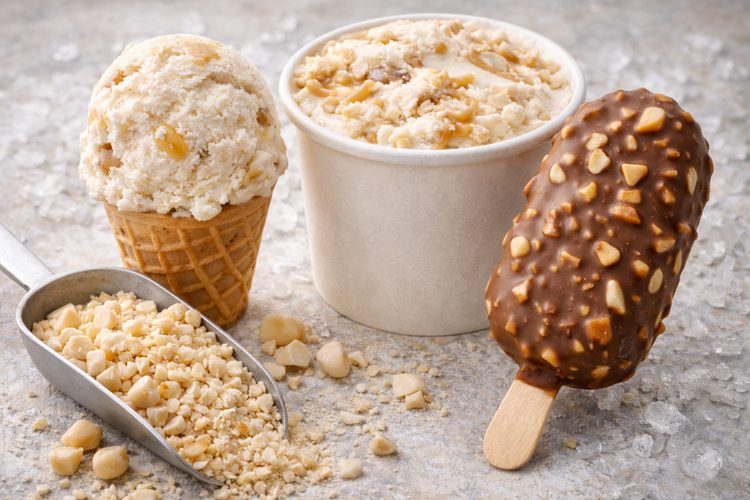
Macadamias can move across multiple end uses, but in frozen desserts and premium ice cream inclusions the commercial question is not simply whether macadamias are a good ingredient. The real issue is which macadamia format will hold its value through freezing, storage, distribution and final consumption. Ice cream and frozen dessert manufacturers are usually trying to protect three things at once: premium visual identity, controlled bite and stable sensory performance from production through shelf life. That makes format selection more technical than it may first appear.
Atlas generally positions macadamia programs by asking what the customer needs the ingredient to do on line and in the finished frozen system. Is the macadamia intended to deliver a premium visible inclusion, a softer buttery nut character, a protected crunchy bite, a clean creamy flavor note in a ripple or base, or a differentiated luxury cue in a retail pint or foodservice dessert program? Those questions shape the right specification more effectively than a generic request for “macadamias for ice cream.”
buyer's perspective: Frozen dessert applications reward specification discipline. Cut size, roast level, residual surface oil, inclusion protection, filling sequence and packaging all influence whether the macadamia remains premium at point of consumption or becomes just another expensive inclusion.
Why macadamias are commercially attractive in frozen desserts
Macadamias sit in a premium tier of nut inclusions. They are valued for their rich, buttery flavor, relatively tender bite compared with harder nuts, and strong premium associations in ice cream, gelato, frozen novelties and plated dessert systems. In a market where brands are trying to signal indulgence, differentiation and upscale positioning, macadamias can justify higher perceived value if they are used correctly.
They are especially useful in applications where the brand wants a luxurious nut note rather than a purely crunchy nut identity. Macadamias can contribute elegance in white chocolate systems, caramel profiles, tropical or island-inspired concepts, coffee and mocha pairings, premium vanilla bases and higher-end dairy-free frozen desserts. The commercial upside is real, but so is the risk of under-specifying the format. A poorly chosen cut, weak roast strategy or unstable inclusion system can erode both texture and margin.
How this topic shows up in real buying decisions
In practice, buyers compare raw, pasteurized, dry roasted and application-processed formats such as diced cuts, granulated material, meal, flour, butter and oil-bearing paste systems. In frozen desserts, the right choice depends on the balance between appearance, bite, blendability, flavor release, fat migration, processing compatibility and total delivered cost.
For macadamia buyers, the usable product menu often includes raw kernels for secondary roasting or coating, dry roasted macadamias for ready-to-use inclusions, diced macadamias for even distribution, granulated cuts for ripple or topping systems, macadamia meal for flavor carry, and macadamia butter or paste for frozen dessert bases and variegates. Which of those makes sense depends on whether the customer is building a scoopable premium ice cream, a gelato line, a novelty bar, a ripple, a crunchy coating system or a plant-based frozen dessert.
Why frozen systems are different from bakery or snack applications
Frozen desserts create a specific type of stress on nut inclusions. The ingredient has to survive cold storage, maintain acceptable bite at sub-zero serving temperatures, and still perform after distribution handling. Inclusions that feel balanced in room-temperature applications can become too hard, too muted or too fragile once frozen into a dairy or non-dairy matrix. This is one reason why macadamia programs for frozen dessert are usually more application-specific than programs for cookies, bars or snack mixes.
The fat-rich nature of macadamias can be an advantage because it helps create a more indulgent flavor impression, but it also means buyers must consider oil behavior, coating needs and how the nut interacts with chocolate, sugar systems, caramel, syrups or frozen base solids. The frozen environment does not remove formulation complexity; it concentrates it.
Common macadamia roles in frozen dessert systems
Premium visible inclusions
These are the macadamia pieces the consumer sees clearly in the pint, scoop or novelty cross-section. In this role, the ingredient is expected to deliver visual luxury and controlled bite. Buyers usually care about cut uniformity, roast appearance, distribution through the base and resistance to excessive fragmentation during inclusion dosing.
Crunch components in ice cream and gelato
Macadamias can add textural contrast in otherwise creamy systems. This may be especially relevant in premium vanilla, caramel, coffee, chocolate-white chocolate and tropical flavor concepts. However, “crunch” must be managed carefully because frozen service temperature amplifies hardness. The buyer therefore has to think beyond size alone and consider roast, coating and serving profile.
Flavor carriers in ripples, swirls and variegates
Macadamia meal, butter or paste may be used where the brand wants nut flavor without relying only on large visible pieces. In these systems, the commercial goal may be flavor layering, richer mouthfeel or premium differentiation in a sauce, swirl or compound. Here the critical variables are grind consistency, oil behavior and flavor intensity rather than visual inclusion count.
Coated inclusions for texture protection
Some manufacturers use chocolate, sugar or fat-based coatings around nut pieces to protect bite and manage moisture interaction. In frozen desserts, this can help preserve crunch, reduce direct exposure to the base and create a more consistent sensory experience. The buyer should state clearly if the program is for coated inclusions rather than plain roasted pieces, because that changes both specification and pricing logic.
Application-specific toppings and foodservice finishing
Foodservice desserts, plated applications and premium sundae programs may use macadamias as top-added inclusions rather than factory-mixed ingredients. In that case, the product may not require the same frozen-system stability as an embedded inclusion, but it may need strong visual quality, clean roast appearance and packaging suited to back-of-house use.
Choosing the right macadamia format
Whole kernels and halves
Whole kernels or larger pieces may be used in premium applications where visual impact matters most, but they are not always the best frozen inclusion choice. At freezer temperature, large nut pieces can create point hardness and inconsistent bite. They may still work in selected novelty bars, hand-finished desserts or luxury scoop shops, but buyers should test them carefully in commercial frozen systems.
Medium and small diced cuts
Diced cuts are often the most practical format for premium ice cream inclusions. They allow better distribution through the base, reduce the risk of over-hard bite points and provide more consistent inclusion count per serving. They are also easier to meter in automated lines and can support stronger cost control than whole-kernel specifications.
Granulated material
Granulated macadamia cuts can work well where the inclusion should be present in every bite without dominating the texture. This may suit gelato, premium dairy desserts, frozen yogurt-adjacent applications or products that need a fine distribution around swirls or chocolate flakes.
Meal, flour and fine particulate systems
These formats are more useful when the goal is flavor contribution, visual flecking or incorporation into compounds rather than visible nut identity. Buyers may consider them in ripple systems, premium frozen bases, bakery-style frozen dessert inclusions or plant-based formulas that need macadamia character without large particulate matter.
Macadamia butter or paste
Macadamia butter and paste can bring richness, nut flavor and a softer luxury cue to swirls, bases or inclusions. In these applications, the buyer should define solids expectations, flow behavior, smoothness and whether the material is for direct blending, variegate manufacture or further formulation into sauces and fillings.
Raw versus roasted macadamias in frozen dessert use
Raw material may be appropriate when the customer wants to apply a custom roast, coat the inclusion, or integrate the macadamia into a later process step. Roasted material is more commonly used when immediate flavor development and ready-to-dose inclusions are needed. Because frozen desserts suppress some flavor perception, the roast decision becomes commercially important. A nut that tastes balanced at ambient conditions may read too mild once frozen into a dairy matrix.
Dry roasted macadamias are often preferred where the buyer wants a stronger developed nut note without additional processing oil. In some applications, the roast may also improve the sensory distinction between the nut and the base. However, over-roasting can create fragility or overly aggressive flavor in delicate vanilla or white chocolate systems, so the right target depends on the finished concept.
Texture management in frozen desserts
Hardness at serving temperature
One of the biggest mistakes in frozen inclusion sourcing is testing only at room temperature. In a premium ice cream or gelato, consumers experience the nut at serving temperature, not at bench temperature. Larger or denser pieces may become harder than intended. Diced macadamias often perform better because they deliver controlled bite without creating overly firm chew points.
Crunch preservation
Manufacturers often want the inclusion to stay crunchy over shelf life. The challenge is that repeated temperature fluctuation, contact with the surrounding matrix and fat migration can reduce the clean textural separation between nut and base. In some systems, coated macadamia inclusions or carefully roasted pieces may help preserve better texture than plain untreated pieces.
Fragility and fines
Macadamias are valued partly because they feel more tender and premium, but that same tenderness means they can generate fines if handling is too aggressive. Buyers should discuss how the product is dosed, mixed or folded into the base, and whether the line creates mechanical stress that would favor one cut size over another.
Flavor pairing logic
Macadamias are especially effective in frozen desserts built around indulgent or upscale flavor systems. Common pairings include white chocolate, vanilla bean, caramel, sea salt caramel, coffee, mocha, dark chocolate, tropical fruit, coconut, honey, maple and premium cookie-style inclusions. In dairy-free frozen desserts, macadamias can also support a richer premium positioning when the base itself needs help achieving indulgent character.
From a sourcing standpoint, these pairings matter because they can change the ideal roast intensity and cut choice. A delicate vanilla base may prefer a lighter roasted diced inclusion, while a dark chocolate or coffee system may benefit from a more developed roast note.
Macadamias in dairy-free and plant-based frozen desserts
Plant-based frozen desserts often need strong differentiation to justify a premium position. Macadamias can help here in two ways. First, as inclusions, they contribute luxury texture and premium flavor cues. Second, as butter or paste systems, they can support richness and creamy perception in bases, swirls or nut-forward concept development.
For buyers working in dairy-free systems, the quote request should clarify whether the macadamia is acting as a visible inclusion, a flavor carrier, a base-enrichment component or a compound ingredient. That distinction changes both the functional questions and the quote structure.
What Atlas would ask before quoting
For macadamia frozen dessert projects, Atlas would usually ask the customer to define the application as clearly as possible. Is the product a premium ice cream pint, gelato, frozen novelty, frozen bakery dessert, ripple system or dairy-free frozen dessert? Then Atlas would want to understand whether the macadamia is meant to create visible premium identity, controlled crunch, creamy flavor carry or a protected coated inclusion.
After that, the quote request becomes more practical. Atlas generally recommends defining target format, application, pack style, destination market and volume rhythm. For this category, Atlas would also want to know cut size, roast preference, whether the inclusion is plain or coated, whether the product is consumer-visible in the finished pack, and whether the program is at trial, validation or repeat commercial stage.
Typical use cases for macadamias on this website include premium bakery, cookies and confectionery, snack mixes, plant-based dairy, sauces and dips. For frozen dessert applications, the brief should still point to a concrete end use such as pints, gelato, novelty bars, variegates or plated desserts rather than a generic request for macadamias.
Commercial planning points
Commercially, frozen dessert projects often develop in stages: trial quantity, validation run, launch volume and repeat replenishment. Atlas uses that logic to guide pack and shipment planning, especially when the customer is coordinating trials with co-manufacturers, seasonal launch windows or premium private label development. A small pilot requirement may prioritize flexibility. A repeat retail program usually needs tighter consistency, forecast discipline and packaging alignment.
When relevant, the brief should also mention whether the program is industrial bulk, foodservice, retail-ready, private label or export-oriented. That single clarification often changes packaging, documentation and timing assumptions. For example, a foodservice topping program may prioritize open-and-use practicality, while an export-oriented premium pint program may require more disciplined case planning and documentation support.
Packaging and handling considerations
Packaging is especially important for premium inclusions because macadamias can be sensitive to mechanical damage and quality drift if handled poorly. Bulk industrial packaging may be appropriate for large ice cream plants dosing inclusions directly into the line. Smaller pack formats may suit R&D kitchens, specialty dessert manufacturers or foodservice finishing programs. Buyers should specify whether they need protective bulk packing, smaller working units or pack styles designed for export movement.
Because macadamias are a premium-cost ingredient, preserving integrity through warehousing and line-side handling is part of cost control. Excessive breakage, fines or inconsistent piece distribution can make a high-value nut perform like a lower-value particulate ingredient, which weakens both product quality and commercial efficiency.
Cost-in-use versus nominal price
Frozen dessert buyers should be particularly careful about comparing only price per pound or price per kilogram. A lower-priced large piece may create too-hard bite and force reformulation. A cheaper raw format may require roasting, sorting or coating steps that the buyer did not initially budget. A more precise diced roasted inclusion may cost more on paper but produce better distribution, easier line performance and more reliable consumer experience.
For premium frozen desserts, cost-in-use often matters more than nominal price. The inclusion has to justify its premium position not just by being present in the formula, but by performing correctly in the scoop, pint or novelty at the moment of eating.
How this topic shows up in premium product development
In real buying decisions, frozen dessert teams often start with a product vision such as “premium white chocolate macadamia pint” or “caramel macadamia dairy-free bar,” but the quote request is still too broad. The program becomes more actionable when the team defines whether the nut should be visually prominent, what bite is acceptable at freezer temperature, whether the inclusion must stay crunchy over shelf life, and whether the nut is being paired with chocolate, ripple, caramel or cookies.
That is why the quote should reflect the real format and route. Whole or kernel material is different from diced cuts, meal, flour, butter or coated inclusions. The commercial logic also changes when the material is raw, roasted or built into an inclusion-protection strategy.
Buyer planning note
Atlas Global Trading Co. uses topics like this to move conversations from broad interest to a specification-minded inquiry. If you are evaluating macadamia supply for frozen desserts, share the target format, pack style, estimated volume and destination using the floating contact form so the next step can be grounded in a real commercial need.
For premium frozen applications, the strongest sourcing discussions usually happen when the buyer brings the actual dessert architecture into the conversation: inclusion size, roast route, coated or plain format, product type, serving profile and launch stage. That makes it far easier to align California partner capabilities with the finished product goal.
Need help sourcing around this macadamia frozen dessert topic?
Use the contact form to turn a product idea into a more practical quote request built around inclusion size, roast route, packaging and launch timing.
- State the exact macadamia format and cut size
- Add target monthly or pilot volume
- Include destination market, pack style and timing
Frequently Asked Questions
What is the main buyer takeaway from “Macadamias in Frozen Desserts and Premium Ice Cream Inclusions”?
The main buyer takeaway is that macadamia sourcing for frozen desserts works best when cut size, roast route, sensory target, inclusion stability, packaging and commercial timing are defined together.
Which macadamia formats are most useful in frozen desserts and premium ice cream lines?
Common formats include raw pieces for further processing, dry roasted pieces for premium inclusions, coated inclusions for texture protection, granulated cuts for even distribution, meal for flavor carry, and butter or paste for ripple systems and premium base development.
Why is cut size so important in frozen dessert applications?
Cut size affects bite hardness at serving temperature, inclusion distribution, visual premium value and line performance. A format that feels acceptable at room temperature may become too hard or uneven once frozen into the final dessert.
Should frozen dessert buyers use raw or roasted macadamias?
It depends on the process route. Raw material may suit secondary roasting or coating programs, while roasted material is often preferred when immediate developed flavor and ready-to-dose inclusions are needed. The correct choice depends on the finished dessert architecture.
What should buyers include in a quote request for macadamias used in frozen desserts?
A useful quote request should include application type, target cut or particle size, raw or roasted requirement, whether the product is plain or coated, packaging style, destination market, estimated volume and the expected shipment or launch timing.