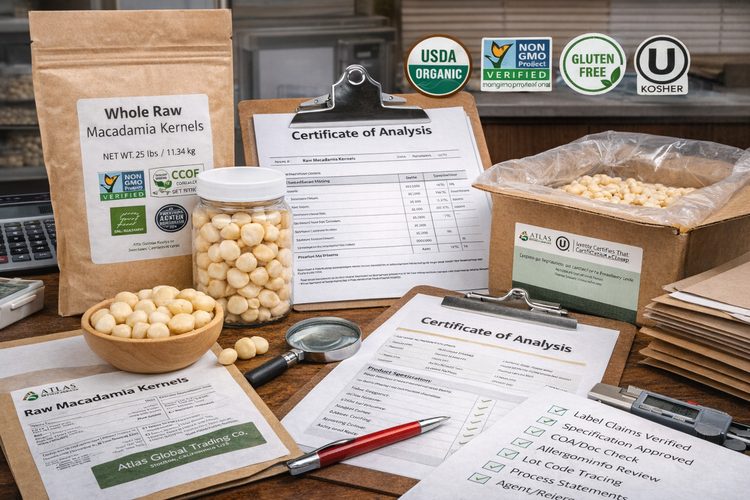
For professional buyers, macadamia sourcing is never only about product availability and nominal price. The stronger commercial result usually comes from aligning product form, intended application, processing status, packaging, label language and documentation before the order is placed. That is especially true when customers, retail chains, importers, foodservice operators or contract manufacturing partners expect specific declarations on the label and a document package that supports supplier approval.
In many real buying situations, claims and QA paperwork become the difference between a fast, comparable quotation and a delayed, high-friction approval cycle. A supplier may have the right macadamia format, but if the documentation set does not support the requested claim structure, the product may still be commercially unusable for the target program. That is why experienced buyers treat claims, specifications and quality documents as part of the product definition itself, not as administrative details that can be solved later.
Why claims and QA documents matter in macadamia programs
Macadamias often sit in premium product categories. They appear in upscale bakery, confectionery, premium snack mixes, culinary retail, foodservice, plant-based applications, ingredient blends, nut butters and export-oriented packaged goods. In each of these categories, claims may influence consumer positioning, importer requirements, retailer acceptance, internal QA signoff and even pricing logic. Once a brand chooses a claim path, the supplier needs to support that path with a coherent document structure.
This means buyers should think about claims and QA documentation at the same time they define kernel format, roast status, cut size, pack format and destination market. If that alignment happens early, the buyer can compare suppliers more efficiently. If it happens late, the program can get trapped in avoidable rework, relabeling, document gaps or approval delays.
Commercial takeaway: macadamia claims should never be treated as marketing language alone. In buyer trade, every claim request has technical, process, packaging and documentation consequences that should be clarified before quotation and before production is booked.
How this topic shows up in real buying decisions
In practice, buyers usually encounter this topic in one of four situations. First, a finished product team wants to make a claim on a retail or foodservice pack and needs confidence that the underlying ingredient supply supports it. Second, a quality team is approving a new supplier and needs a predictable documentation package. Third, an export customer asks for a specific declaration or compliance file set. Fourth, a private label or contract manufacturing program needs documentation consistency across repeated deliveries.
At that point, the buyer is no longer choosing only between raw macadamias, roasted macadamias, diced macadamias or macadamia butter. The buyer is choosing between different documentation burdens and commercial risks. A technically suitable product with weak paperwork may still be a poor sourcing choice if it slows approvals or creates downstream claims exposure.
Claims should follow the actual product and process route
One of the most common sourcing mistakes is to begin with desired claims rather than with the real product and process route. Claims should be supported by how the macadamia product is sourced, handled, processed, packed and documented. That does not mean the buyer needs a long regulatory memo before requesting a quote, but it does mean the buyer should define the claim direction early enough for the supplier conversation to remain realistic.
For example, a whole raw macadamia kernel for industrial reprocessing does not create the same claims discussion as a finished roasted retail pouch. A plain diced inclusion for bakery use does not create the same document expectations as a premium export snack program. The commercial logic changes again when the product is pasteurized, flavored, packed under private label or routed to a destination with more specific importer requirements.
Common claim categories buyers usually discuss
The exact claim set varies by customer and destination, but most professional buyers think in a few repeatable categories rather than in a random list of marketing terms.
1. Identity and product description claims
These are the most basic but also the most commercially important. They define what the product is and how it is described on specification sheets, labels and sales documentation. Examples include raw macadamias, roasted macadamias, dry roasted macadamias, oil roasted macadamias, diced macadamias, macadamia flour, macadamia butter or macadamia oil. If the description is inconsistent across documents, approvals become slower and product comparisons become weaker.
2. Process-related claims
These involve how the product has been handled or treated. Buyers may ask whether the product is raw, roasted, pasteurized, seasoned or otherwise further processed. In commercial terms, these claims often affect microbiological expectations, sensory targets, documentation needs and downstream labeling language. A supplier quote is only useful if the process state is clear and tied to the actual product form.
3. Quality and attribute claims
These can include buyer-facing or customer-facing statements tied to visual grade, flavor expectations, defect tolerance, sizing consistency or pack style. In ingredient trade, these claims are often handled more through specifications and approval documents than through front-of-pack language, but they still materially affect the commercial offer.
4. Market-specific or customer-specific claims
Some programs need tailored declarations or custom documents because the product is being sold into a retailer, distributor, industrial account or export market with its own rules. In these situations, the buyer should assume that documentation requirements may differ by destination and should be confirmed early.
What QA teams usually want before approving a macadamia supplier
Most QA and procurement teams do not approve a macadamia program based on a sample and a price sheet alone. They usually want a structured document package that helps them verify what the ingredient is, how it is controlled and whether it fits the intended application. The stronger the documentation set, the easier it is to move from research to a real commercial relationship.
Typical review items include:
- product specification sheet with clear product description, form and process state,
- certificate of analysis format or lot release data structure,
- allergen information and ingredient identity confirmation,
- packaging description and pack size details,
- traceability or lot coding approach,
- storage and shelf-life guidance,
- process declarations relevant to the requested claim set, and
- any customer-specific or destination-specific supporting files.
Not every program needs the same depth of paperwork. A domestic ingredient trial and a finished export retail program do not carry the same documentation burden. But the point is consistent: documentation should reflect the real use case rather than relying on a generic data pack that does not match the program.
How documentation changes by product form
Macadamias are not a single commercial product. Whole kernels, halves, pieces, diced cuts, meal, flour, butter and oil each create slightly different documentation and claims questions. Whole kernels for premium retail may emphasize visual grade, defects and pack presentation. Diced or granular forms for bakery may focus more on cut size, fines, functionality and consistency. Macadamia butter and oil streams create their own specification logic around texture, oil separation, viscosity or sensory profile.
That is why buyers should avoid broad requests such as “send all documents for macadamias.” A more useful request is tied to the exact form being quoted. The right paperwork for whole roasted kernels is not automatically the right paperwork for macadamia butter or for refined macadamia oil.
Why label claims and commercial claims must match
One common failure point in food ingredient sourcing is a mismatch between what sales teams, purchasing teams and label teams think is being bought. A supplier may quote one process state, while the brand team assumes a broader claim position, and the QA team may be reviewing documentation against a third interpretation. When that happens, the issue is not only technical. It becomes commercial because the buyer can no longer compare offers cleanly or move the program into production with confidence.
The best practice is simple: the claim language, the internal specification, the quotation description and the incoming QA review should all point to the same product reality. That makes trials more meaningful, approvals faster and replenishment more repeatable.
Atlas trade note: a stronger macadamia RFQ usually describes the desired product, process state, pack format, claim direction and destination market in one brief. That improves quote quality and reduces avoidable back-and-forth between sales, QA and regulatory teams.
Documents buyers often review before a retail or private label launch
Retail-ready and private label macadamia programs usually require more alignment than bulk ingredient supply. The buyer may need not only the ingredient specification, but also packaging declarations, label support, barcode structure, case information and destination language coordination. These details can influence lead time, MOQ and pack approval timing just as much as the product itself.
Before launch, buyers often want confidence around:
- the final product description used on artwork and shipping documents,
- the ingredient statement logic,
- pack format and net weight consistency,
- case coding or lot coding format,
- shelf-life statement and storage instructions, and
- supporting QA documents that match the final marketed item.
For premium retail macadamia programs, the documentation package becomes part of the commercial readiness of the product. A visually attractive private label pack is not commercially complete if the supporting paperwork is weak or inconsistent.
Domestic versus export document logic
The same macadamia product may require a different document emphasis depending on where it is sold. Domestic U.S. industrial programs often prioritize approval speed, lot release consistency and operational clarity. Export programs may require broader paperwork coordination because the product must move through freight, customs, importer review and destination-side commercial handling before it reaches the final customer.
For that reason, Atlas typically encourages buyers to mention destination market early. Even when the underlying product is the same, destination-specific expectations around labels, pack markings, document language or importer files can materially change the program timeline and the quotation structure.
How QA documentation affects quotation accuracy
Good documentation does not only help after the quote. It improves the quote itself. When the buyer defines the needed claim set and the expected QA file structure early, the supplier can quote a more realistic program. That matters because documentation requirements may affect product selection, processing route, packaging choice, lead time, MOQ and commercial complexity.
A quote for standard industrial raw kernels is not the same as a quote for a claim-sensitive retail pack or an export private label program. If the buyer waits until after pricing to mention claim support or special QA requirements, the comparison between suppliers becomes less reliable. The offers may no longer be comparable because the suppliers were not quoting the same underlying obligation.
What Atlas would ask before quoting
Atlas usually encourages buyers to define the documentation and claim path with the same discipline used for the physical product. A more practical quote request often answers the following:
- What exact macadamia format is needed: whole, pieces, diced, meal, butter or oil?
- What is the process state: raw, pasteurized, dry roasted, oil roasted, flavored or otherwise treated?
- Is the program bulk industrial, foodservice, retail-ready, private label or export-oriented?
- What label or claim direction is already known?
- What QA documents are required for supplier approval or customer signoff?
- What is the destination market?
- What is the expected order volume and timing?
When these inputs are available early, Atlas can structure a more specification-minded quotation instead of a generic availability answer.
How this topic shows up in real commercial workflows
Most successful macadamia programs move through a sequence that looks something like this: initial product discussion, draft specification review, sample or trial, QA document evaluation, quotation refinement, packaging or artwork alignment where relevant, and then final booking. The reason this workflow works is that it connects commercial interest with operational reality. Claims are not handled in isolation, and QA paperwork is not left until the last minute.
That structure is especially useful when the program includes multiple stakeholders. Procurement may be focused on price and lead time, QA on documentation and approval, marketing on claims and presentation, and operations on packaging and logistics. The stronger quote request helps all four groups work from the same product definition.
Commercial planning points
From a trading standpoint, the most durable macadamia programs are built around repeatability. That means not only clear pricing and shipment cadence, but also stable specification language and repeatable documents. If every reorder triggers a new round of questions about claims, declarations or release paperwork, the supply program becomes harder to scale.
Strong buyers usually try to stabilize:
- the product description used across PO, spec sheet and shipment documents,
- the claim set or process declaration logic,
- the recurring QA file package,
- the packaging and case identification structure, and
- the commercial route for domestic or export replenishment.
This reduces friction over time and makes repeat orders easier to place, approve and receive.
How to build a stronger RFQ for this topic
A weak inquiry says: “Please quote macadamias and send documents.” A stronger inquiry says: “Please quote dry roasted macadamia pieces for premium snack application, retail-ready private label, export destination, target launch in Q3, and please advise which QA and support documents are available for supplier approval and label review.” The second version gives the supplier enough context to respond in a way that matches the real commercial requirement.
The objective is not complexity for its own sake. The objective is to make sure the product being quoted, documented, approved and eventually shipped is the same product being planned by the buyer.
Buyer planning note
Atlas Global Trading Co. uses topics like label claims and QA documentation to help buyers move from broad interest to a more precise commercial brief. For macadamias, the best outcome usually comes when the product form, process route, packaging, claim direction and destination market are clarified together. That gives both buyer and supplier a better chance of moving from research to a usable, approval-ready quotation.
If you are evaluating macadamias for industrial use, retail-ready supply, private label development or export distribution, Atlas can use the same structure covered here to help organize the next step into a more specification-minded sourcing discussion.
What to include in a macadamia claims and QA inquiry
A more practical buyer brief usually includes:
- the exact macadamia format and process state,
- the intended application or sales channel,
- whether the program is industrial bulk, foodservice, retail-ready or private label,
- the destination market,
- the main claim direction or label expectation,
- the core QA documents needed for approval,
- target trial, monthly or container volume, and
- the timing for sample, quote and launch planning.
Even when all details are not final, these inputs usually make supplier comparisons more realistic and help avoid claim-document mismatches later.
Need help sourcing around this macadamia claims topic?
Use the contact form to turn research on label claims and QA documents into a practical quote request for Atlas.
- State the exact macadamia format and process status
- Add claim direction and required QA documents
- Include destination market, volume and timing
Frequently Asked Questions
What is the main buyer takeaway from “Label Claims and QA Documents for Macadamia Programs”?
The main buyer takeaway is that macadamia programs move more smoothly when claims, specifications, QA documentation, packaging and destination market requirements are aligned before quotation and production begin.
Why do label claims matter so much in macadamia sourcing?
Claims affect product positioning, specification review, document requirements, supplier approval and commercial risk. A buyer should never assume a claim can be added later without confirming supporting documentation and process alignment.
What QA documents should buyers typically ask for?
A practical buyer usually reviews the product specification, certificate of analysis structure, allergen information, lot traceability details, process declarations, packaging information and any additional customer or destination-specific documents required for approval.