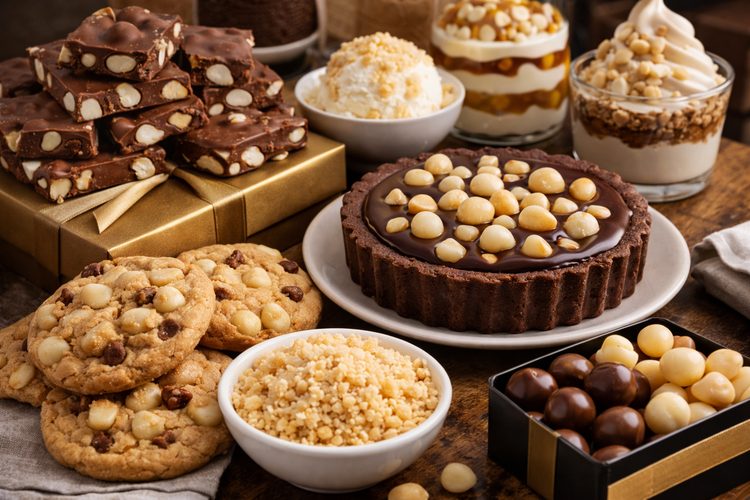
Macadamias can move across multiple end uses, but premium dessert positioning with macadamias is really about matching the right macadamia format to the finished product and the commercial role that dessert needs to play. In practice, dessert developers are not buying macadamias only for ingredient cost. They are using them to create a stronger sensory impression, a more premium visual, a richer mouthfeel or a more giftable and upscale shelf story. The better commercial outcome usually comes from aligning specification, process route, packaging and shipment timing before the order is placed.
That matters because premium dessert programs are usually judged by details. A macadamia inclusion that looks elegant in a pastry line may not be the right choice for a frozen dessert swirl. A macadamia butter route that works in a luxury filling may not be right for a cookie base or plated dessert garnish. Product form, process stage and route to market need to be considered together.
Why macadamias help move desserts into a premium tier
Macadamias have strong premium signaling power. They are associated with richness, indulgence and a more refined dessert experience than many standard nut ingredients. In desserts, they can contribute visible luxury, softer buttery crunch, creamy nut flavor and an upscale impression that supports higher menu prices or stronger retail price positioning.
For many buyers, that is the key commercial point. Macadamias are often used not because they are the cheapest nut in the formula, but because they can help the finished dessert move from standard to elevated. In bakery, frozen desserts, confections and dessert gifting, that premium signal can materially change the consumer’s willingness to pay and the retailer’s willingness to give the line stronger placement.
In dessert development, macadamias usually work best when their role is clearly defined. They may add crunch, deliver creaminess, support a premium visual, create flavor contrast, soften texture, or simply raise the perceived value of the dessert line.
How this topic shows up in real buying decisions
In practice, buyers typically compare raw, pasteurized, dry roasted, oil roasted and processed formats such as diced cuts, meal, flour, butter and oil. The right choice depends on the balance between appearance, bite, blendability, oil release, labeling goals and total delivered cost. In premium desserts, appearance and sensory payoff usually matter more than in lower-tier everyday sweet products, so specification discipline becomes even more important.
For macadamia buyers, the usable product menu usually includes raw macadamias, pasteurized macadamias, dry roasted macadamias, oil roasted macadamias, diced macadamias, granulated pieces, meal, flour, butter, paste and oil. Which of those makes sense depends on whether the customer is manufacturing further, producing bakery lines, filling premium retail packs, building plated dessert components or planning export distribution.
Macadamias in bakery desserts
In bakery, macadamias are especially relevant where the finished product needs visible premium character. Cookies, blondies, cakes, tart shells, pastry fillings, laminated products, muffin toppings and premium bakery inclusions can all benefit from macadamias when the format is chosen correctly. Larger kernels or style-selected pieces can help create an immediate upscale look, while diced cuts and meal may be better for even distribution or internal richness.
The commercial question in bakery is usually whether the nut needs to be seen clearly, felt texturally, or integrated into the crumb or filling. A premium cookie line may want visible roasted pieces. A cake batter may need smaller cuts or meal for better distribution. A pastry cream or nut filling may work better with butter or paste. The same nut category supports multiple routes, but the price and the supply logic change with the intended use.
Macadamias in confectionery and chocolate-based desserts
Macadamias are highly compatible with confectionery because they can add both luxury cues and sensory balance. In chocolate systems, they often soften the overall profile with a round, creamy nut note. In praline-style concepts, dragées, bark, enrobed items, truffles and filled confectionery, they may contribute either premium crunch or refined nut body depending on format.
From a buyer standpoint, confectionery buyers often need to think carefully about whether the macadamia is a topping, a center ingredient, a paste phase or a visible whole inclusion. Each route changes not only the finished eating experience but also the packaging and commercial structure of the program.
Macadamias in frozen desserts
Frozen desserts introduce another layer of decision-making. Macadamias can be used as inclusions, ripples, brittle components, coated pieces, pastes or premium swirl elements in ice cream, frozen novelties, gelato and plated frozen dessert formats. In these systems, the format must be chosen not only for taste but for how it behaves under cold storage and through the consumer eating experience.
Some customers want visible crunch that survives cold conditions. Others want softer nut richness through a paste or butter route. Others want premium visual appeal through coated or roasted pieces. The best route depends on how the finished product is served and where the macadamia is expected to show up in the first bite.
Texture strategy: crunch, creaminess and contrast
Texture is one of the strongest reasons to use macadamias in dessert positioning. Compared with harder or more assertive nuts, macadamias often deliver a rounder, softer crunch and a richer mouthfeel. That can be especially useful when the dessert needs to feel indulgent without becoming aggressive or overly dry in bite.
This allows macadamias to work across multiple dessert textures. Whole or large pieces can create premium crunch in cookies, bark and toppings. Diced cuts can add controlled bite in cakes, bars and frozen desserts. Meal and flour can increase richness in crumb systems. Butter and paste can create creamy spreadability or filling structure in more luxurious applications.
Flavor positioning and pairing logic
Macadamias are often chosen because their flavor profile integrates well with premium dessert directions. They pair naturally with chocolate, caramel, vanilla, coffee, coconut, tropical fruits, white chocolate, butterscotch, maple, honey and dairy-based cream notes. They can also work in more modern dessert profiles where a premium nut note supports indulgence without overpowering the rest of the formula.
That flexibility is commercially useful because it lets buyers use macadamias across both classic and trend-adjacent dessert lines. The nut can either play a leading role, as in a macadamia cookie or premium nut tart, or a supporting role, as in a caramel-macadamia filling or a white-chocolate-macadamia frozen dessert concept.
Raw versus roasted for dessert programs
The choice between raw and roasted matters in desserts. Raw formats may make more sense when the buyer wants downstream roasting control, softer flavor integration or later-stage process flexibility. Roasted formats may be more appropriate when the dessert needs immediate nut character, stronger aroma development or visible toasted appeal. This can be particularly important in retail-ready desserts and menu items where the nut flavor must communicate value quickly.
Roasting choice can also affect visual color, crumb interaction, coating performance and total delivered cost. That is why dessert buyers usually benefit from deciding not only what format they need, but what flavor expression they want the nut to carry.
Meal, flour, butter and paste in premium dessert systems
Macadamia meal, flour, butter and paste can all play valuable roles in premium desserts, especially when the objective is richness rather than visible inclusion. Meal and flour may be useful in baked systems, tart bases, crumbs, premium coatings and composite dessert structures. Butter and paste can be especially relevant in fillings, spreadable layers, cream-like applications, dessert sauces, mousses, plated dessert elements and premium retail jars or tubs.
In commercial terms, these formats often become relevant when the dessert is meant to feel more luxurious without relying only on whole visible nuts. They can also support smoother textures and more consistent distribution in scaled production.
Visual premium cues and merchandising value
Macadamias are visually useful in premium desserts because they help create a strong first impression. In retail bakery, gift confectionery and plated desserts, visual quality often determines whether the customer perceives the product as worth the premium price. Larger pieces, cleaner cuts and more disciplined topping use can create stronger product photography, better display appeal and a more upscale consumer expectation.
This is one reason the macadamia brief should identify whether visual performance is critical. The commercial value of a visible topping or premium inclusion is not the same as that of a hidden ingredient. Buyers should quote the product they actually need for the visual job.
Pack style and route to market
Premium dessert programs may be industrial bulk, foodservice, retail-ready, private label or export-oriented. That distinction affects the whole commercial structure. Bulk ingredient supply for bakery production follows different logic from consumer-packed dessert gifting, premium frozen retail, or export shelf dessert programs. Once packaging enters the conversation, the product is no longer just an ingredient. It becomes part of a market-facing system.
When relevant, the brief should therefore mention whether the program is industrial bulk, foodservice, retail-ready, private label or export-oriented. That single clarification often changes packaging, documentation and timing assumptions.
Commercial planning points
Commercially, dessert projects often develop in stages: trial quantity, validation run, launch volume and repeat replenishment. Atlas uses that logic to guide pack and shipment planning, especially when retail packaging, export retail or private label is part of the conversation. A dessert concept that looks attractive in a sample kitchen may still need validation for line performance, packaging behavior, unit economics and market fit.
From a trading standpoint, the best programs are built around repeatability. That means clear documentation, agreed packaging, sensible shipment cadence and a commercial structure that supports continuity rather than one-off emergency buying. Premium dessert lines are especially sensitive to inconsistency because the buyer is often selling not only taste but also visual luxury and brand experience.
What Atlas would ask before quoting
For macadamia dessert projects, Atlas would usually recommend translating the product idea into a quote request with five points: target format, application, pack style, destination market and volume rhythm. More specifically, Atlas would usually ask whether the dessert is bakery, confectionery, frozen or plated; whether the macadamias must be visible or integrated; whether the flavor should be raw, lightly toasted or more developed; and whether the product is for industrial use, foodservice or finished retail sale.
Those details help reduce avoidable back-and-forth and improve comparability across California partner options instead of leading to a generic price-only inquiry.
Buyer planning note
Atlas Global Trading Co. uses topics like this to move conversations from broad interest to a specification-minded inquiry. In dessert development, macadamias work best when the buyer defines exactly what the nut should do in the finished product: add crunch, deliver creaminess, support a premium visual, strengthen a luxury flavor story or lift the overall value perception of the line.
If you are evaluating macadamias for bakery, confectionery, frozen desserts, plated dessert components, private label sweets or export-oriented premium dessert programs, share the format, pack style, estimated volume and destination using the floating contact form so the next step can be grounded in a real commercial need.
Need help sourcing macadamias for a premium dessert application?
Use the contact form to turn this dessert concept into a practical quote request with application, format, packaging and shipment timing clearly defined.
- State the exact macadamia format and dessert application
- Add target monthly or trial volume and pack style
- Include destination market and target timing
Frequently Asked Questions
What should buyers define first when using macadamias in premium dessert programs?
Buyers should define the exact macadamia format, the dessert application, the target visual effect, texture expectation, pack style, destination market and volume rhythm. Premium dessert programs work best when the ingredient role and commercial route are clear before quotation.
Which macadamia formats are commonly used in dessert applications?
Depending on the concept, buyers may use whole kernels, style-selected pieces, diced cuts, roasted inclusions, meal, flour, butter, paste or oil. The correct format depends on whether the dessert needs crunch, creaminess, premium visual appeal, nut flavor or process-ready functionality.
Can macadamia dessert concepts work for both domestic and export programs?
Yes. The same premium dessert concept can often be adapted for domestic, foodservice, retail-ready, private-label and export-oriented programs, but packaging, shelf-life planning, documentation and shipment assumptions may change by channel and destination.