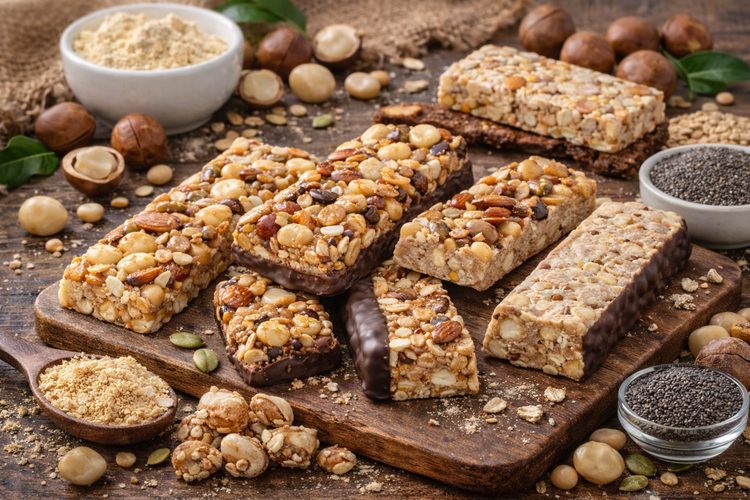
Macadamias in bars and better-for-you snacking is really about matching the right macadamia format to the finished eating experience and the commercial structure behind it. In practice, bar and functional snack buyers are rarely choosing a nut only for nominal price. They are deciding what the ingredient needs to do on line and in the final pack: add crunch, deliver creaminess, support a premium visual, improve indulgence in an otherwise health-positioned product, or contribute nut flavor without creating processing problems.
That is why a stronger commercial outcome usually comes from aligning format, process route, binder system, pack style and shipment timing before the order is placed. A premium snack bar, a protein bar, a nut-and-seed cluster, a granola bite and a coated wellness snack may all use macadamias, but they do not ask for the same ingredient form or commercial brief.
Why macadamias matter in better-for-you categories
Macadamias are often introduced into better-for-you snacking because they offer something many health-positioned categories still need: a premium indulgence signal. In a crowded market of oat bars, nut-and-seed bars, functional snacks and protein-positioned items, macadamias can help move a product from merely healthy to more desirable, more premium and more giftable. They can soften the harshness of highly fortified formulas, support a richer flavor impression, and give the product a more curated look.
Commercially, that can be important because many snack buyers want to balance wellness messaging with repeat purchase appeal. A bar can have a strong nutrition story, but if the eating experience feels dry, utilitarian or overly technical, it can struggle on shelf. Macadamias can help bridge that gap when used correctly.
In functional snacking, the macadamia brief should always answer a practical question: is the nut there for visible premium identity, texture contrast, fat-rich mouthfeel, flavor support, or a stronger consumer-perceived value story? The answer changes the best sourcing route.
How this topic shows up in real buying decisions
In practice, buyers compare raw, pasteurized, dry roasted, oil roasted and processed formats such as diced cuts, meal, flour, butter and oil. The right choice depends on the balance between appearance, bite, blendability, oil release, nutrition positioning, label goals and total delivered cost. A bar system that needs visible nut pieces is different from one that needs creamy dispersion. A protein-forward matrix behaves differently from a chewy fruit-and-nut system. A coated cluster has different requirements from a compressed bar or baked bite.
For macadamia buyers, the usable product menu usually includes raw macadamias, pasteurized macadamias, dry roasted macadamias, oil roasted macadamias, diced macadamias, granulated pieces, meal, extra fine flour, butter and oil. Which of those makes sense depends on whether the customer is manufacturing further, cold-forming a bar, baking a snack, building a premium nut cluster, packing for retail or planning export distribution.
What macadamias do in bar systems
In bars, macadamias are usually chosen to do one or more of five jobs. First, they can add premium visual appeal, especially when larger cut sizes are visible on the bar face or in cross-section. Second, they can contribute a softer, richer crunch than some harder nut inclusions. Third, they can help round out flavor in high-protein or low-sugar systems that otherwise taste too technical. Fourth, they can deliver fat-rich mouthfeel when meal, butter or fine particulate forms are used. Fifth, they can support brand positioning by elevating a bar into a more premium or specialty retail tier.
That means the ingredient should be selected according to the role. A visible hero inclusion is not the same as a binder-phase ingredient. A protein snack cluster is not the same as a creamy bar filling. A keto-style snack may use fat contribution differently from a classic fruit-and-nut bar.
Choosing the right format for bar applications
For macadamias, the quote should reflect the real format and route. Whole or kernel material is different from diced, meal, extra fine flour, butter or oil. The commercial logic also changes when the material is raw, pasteurized, dry roasted or oil roasted.
Whole or large-style pieces may be relevant when the customer wants strong visual premium cues in a larger-format bar or cluster. Diced or chopped macadamias often make more sense when piece distribution and cost control both matter. Meal and flour can be useful when the nut is part of the structural matrix or when a smoother texture is desired. Butter and oil may be relevant when the formula needs creaminess, richness or support in binding and mouthfeel.
Raw versus roasted in better-for-you snacks
Raw macadamias may be selected when the buyer wants downstream control over flavor development, coating, grinding or baking interaction. Roasted macadamias may make more sense when immediate flavor and snack-ready character are needed, especially in products where the nut will remain perceptible after processing. Roasted formats can be particularly useful when the finished bar has a short ingredient deck but still needs a more indulgent taste profile.
The right choice depends on how much thermal treatment remains in the line. A baked bar, a cold-formed bar and a chocolate- or yogurt-coated snack each place different demands on the inclusion. Buyers should therefore specify not only the macadamia format but the process route around it.
Texture management: crunch, chew and bite balance
Texture is one of the biggest reasons buyers use macadamias in bars. Compared with harder inclusions, macadamias can provide a more rounded bite and a premium contrast inside chewy or dense matrices. However, the right texture effect depends on cut size, roast condition, binder phase and total inclusion level. Large pieces may create a dramatic visual and sensory cue, but they can also influence bar integrity and piece migration. Smaller cuts may distribute more evenly but offer less dramatic premium signaling.
In better-for-you snacking, the challenge is usually balance. Too much dense protein structure can make a bar tough. Too much syrup or binder can make it sticky. Too much soft nut butter can reduce textural contrast. Macadamias can help improve this balance, but only when the form matches the matrix.
Macadamia butter, meal and flour in functional systems
When buyers move beyond visible inclusions, macadamias can still be useful in the internal structure of the snack. Macadamia butter may support creamy binder systems, premium filling phases or indulgent nut-based layers. Meal and flour can contribute solids, richness and nut flavor in bars that want a less obvious particulate effect. Extra fine formats may be useful in nutritional or plant-based formulas where smoother integration matters more than visible nut identity.
From a commercial standpoint, these routes are common when the product is positioned as premium wellness rather than simple trail mix in bar form. The customer is no longer buying only for inclusion identity. They are buying for system behavior and mouthfeel improvement.
Binder compatibility and line performance
Macadamias do not work in isolation. In bars and better-for-you snacks, they interact with syrups, fibers, proteins, oats, seeds, fruit pieces, chocolate systems and sweetener structures. That is why buyers should think beyond the ingredient name and consider whether the chosen format fits the binder system. Diced roasted kernels may work well in one cold-form bar but create issues in another if the binder is too soft or if piece distribution is inconsistent. Nut butter may help in one protein snack but create excess richness or oil perception in another.
This is also why the quote should reflect the actual application rather than a generic category term like “protein bar.” The more clearly the customer defines the process style and matrix, the easier it becomes to discuss workable California partner options.
Nutrition positioning and ingredient storytelling
Bars and better-for-you snacks are often sold through a combination of front-of-pack claims and premium ingredient cues. Macadamias can contribute strongly to the second part of that equation. They may help support a cleaner premium story, a gourmet wellness position, a nut-forward identity or a more indulgent interpretation of better-for-you snacking. In some formulas, they may also help reduce the sense that a product is built entirely around technical protein ingredients.
That does not mean macadamias are always the cheapest route. It means they can improve the value perception of the finished product. In better-for-you categories, that can justify a stronger price position or help differentiate the bar from a crowded field of simpler nut and seed formulas.
Common bar and snack formats where macadamias work well
Macadamias can be used across several better-for-you product formats. These include protein bars, nut-and-seed bars, premium cereal bars, keto-style fat-forward bars, fruit-and-nut bars, baked snack bites, clusters, breakfast snacking formats, indulgent wellness snacks and coated bar systems. In each case, the macadamia can be used differently. One concept may need visible roasted pieces. Another may need a soft nut base or internal creamy layer. Another may rely on the macadamia mainly to raise the perceived quality of the blend.
This is why the product brief should always match one of those concrete end uses rather than remaining at a broad category level.
Retail packaging and shelf strategy
Packaging matters because bars and better-for-you snacks are often sold as retail-ready programs rather than industrial inputs. Single-bar wrappers, carton-packed multipacks, display-ready shelf units, premium snack pouches and export retail case packs all create different commercial expectations. A premium macadamia bar for specialty retail may justify different pack graphics and case logic than a mainstream better-for-you multipack intended for volume distribution.
When relevant, the brief should mention whether the program is industrial bulk, foodservice, retail-ready, private label or export-oriented. That single clarification often changes packaging, documentation and timing assumptions.
Commercial cost logic in better-for-you categories
From a pricing standpoint, macadamias are usually not treated as commodity fillers in bar systems. They are often used to improve premium positioning, create a stronger value signal or support a higher-end product architecture. That means the commercial decision is rarely just whether the ingredient is cheap enough. The better question is whether the chosen macadamia format helps the bar justify its shelf price, retailer appeal and repeat purchase potential.
In some cases, a visible but controlled use of macadamias is enough. In others, a stronger macadamia identity is part of the product concept. The correct commercial choice depends on the final market position, not only the formula spreadsheet.
What Atlas would ask before quoting
For macadamia bar and better-for-you snack projects, Atlas would usually recommend translating the product idea into a quote request with five points: target format, application, pack style, destination market and volume rhythm. More specifically, Atlas would usually ask whether the product is a protein bar, nut bar, cluster, bite or coated snack; whether the macadamias need to be visible or integrated; whether the format should be raw or roasted; whether the product is retail-ready or still an industrial build; and what timeline matters most.
Those details reduce avoidable back-and-forth and improve comparability across possible California supply routes. They also help distinguish between inclusion-grade, texture-grade and system-function ingredients.
Commercial planning points
Commercially, these projects often develop in stages: trial quantity, validation run, launch volume and repeat replenishment. That is especially relevant in better-for-you snacking because texture, bite, shelf behavior and consumer response often need validation before full scale. Atlas uses that logic to guide pack and shipment planning, especially when retail packaging, export retail or private label is part of the conversation.
From a trading standpoint, the best programs are built around repeatability. That means clear documentation, agreed packaging, sensible shipment cadence and a commercial structure that supports continuity rather than one-off emergency buying.
Buyer planning note
Atlas Global Trading Co. uses topics like this to move conversations from broad interest to a specification-minded inquiry. If you are evaluating macadamias for bars, clusters, bites or better-for-you snack systems, the strongest next step is to define what the ingredient must do in the finished product: add crunch, deliver creaminess, support a premium visual, improve indulgence, carry seasoning or contribute nut flavor without slowing down production.
If you are evaluating macadamias supply, share the format, pack style, estimated volume and destination using the floating contact form so the next step can be grounded in a real commercial need.
Need help sourcing macadamias for bars or better-for-you snacks?
Use the contact form to turn this research topic into a practical quote request with application, format, packaging and shipment timing clearly defined.
- State the exact macadamia format and snack application
- Add target monthly or trial volume and pack style
- Include destination market and target timing
Frequently Asked Questions
What should buyers specify first when using macadamias in bars and better-for-you snacks?
Buyers should define the exact macadamia format, the bar or snack type, target texture, binder system, pack style, destination market and volume rhythm. A more detailed application brief usually leads to a more useful and comparable quotation.
Which macadamia formats are commonly used in bar systems?
Depending on the application, buyers may use whole or halved kernels, diced macadamias, granulated pieces, meal, flour, butter or oil. The right format depends on whether the bar needs visual identity, crunch, creaminess, binding support or a premium flavor note.
Can macadamia bar concepts work for both domestic and export programs?
Yes. The same product logic can apply across domestic, retail-ready, private-label and export-oriented snack programs, but packaging, shelf-life planning, case configuration and labeling requirements may vary by market.